

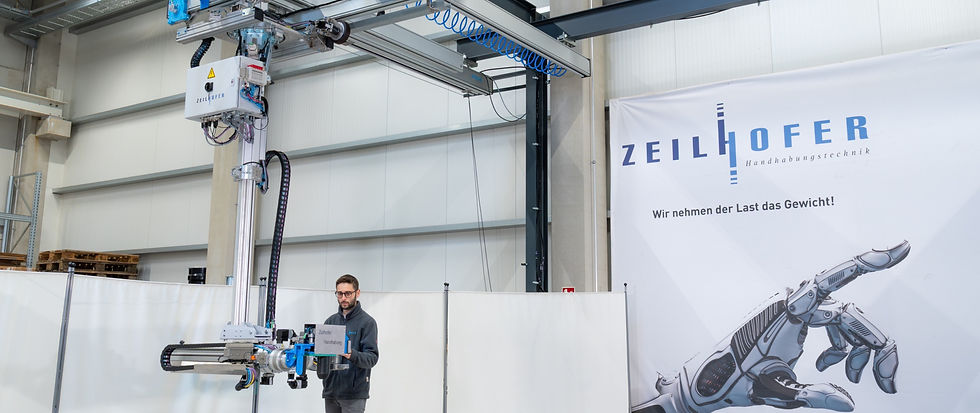
Hubachse Zh90 kollaboriert mit Synchronauszug
Hubachse Zh90 kollaboriert mit Synchronauszug
Guide · Selection & Comparison
MANIPULATOR OR COBOT? WHEN IS WHICH SOLUTION WORTH IT?
Manual, collaborative, or automated load management, objectively compared
Collaborative robots are considered a promising answer to the skilled labor shortage and the pressure of tight production cycles. Classic manipulators have proven their worth in ergonomic load handling for decades. And the ZH90 lifting axis from ZHHT combines both worlds in one system. This guide shows when which technology is truly the right fit.
CHAPTER 1
Introduction
Collaborative robots, or cobots for short, have been considered a promising solution to the skilled labor shortage and increasing production complexity for several years. At the same time, classic manipulators have proven their worth in ergonomic load handling for decades. Those currently investing in handling technology often face the question: manipulator or cobot?
The answer with ZHHT isn't necessarily an either-or: The ZH90 lifting axis is designed as a manual and/or collaborative lifting axis, thus already covering many classic cobot applications. This guide objectively compares all three approaches. For a broader comparison with cranes and classic industrial robots, see our guide "Manipulator, Crane or Robot Compared" .


CHAPTER 2
What is a cobot?
A cobot (collaborative robot) is a robotic arm that can work directly next to or alongside employees without a separating safety fence. Integrated force and torque sensors stop the movement upon contact, making the cobot safer than traditional, fenced-in industrial robots.
Classic cobots are usually freely programmable, multi-axis robot arms that perform repetitive tasks such as pick-and-place, screwing or palletizing fully automatically and without constant manual guidance.
CHAPTER 3
What is a manipulator?
A manipulator guides the load using a rigid mechanism. The movement is controlled manually by the operator; the system simply handles the weight and prevents unwanted oscillation. Unlike a cobot, a traditional manipulator is not automated but manually guided, requiring no programming and offering immediate flexibility when dealing with different components.
Our guide "What is a manipulator?" explains more about how it works.
CHAPTER 4
The ZH90 lifting axis in collaborative mode: the best of both worlds
The ZH90 lifting axis is designed as a manual and/or collaborative lifting axis, a lifting aid developed for direct use in human workspaces. Thanks to integrated safety features, it can be operated without traditional safety barriers such as fences. This creates a shared workspace where humans and machines work together productively and safely.
Force and torque sensors
They detect critical loads and trigger automatic stop functions in case of collisions, using the same safety logic as classic cobots.
Two telescopic aluminum profiles
Despite its lightweight aluminum construction, heavy weights can be lifted and moved without difficulty, and with the rail option, even over longer distances.
Ausfallsicher durch manuellen Fallback
If the collaborative mode fails, the ZH90 can always be operated manually. The process does not stop.
Teach-in programming
Intuitive programming even without in-depth programming knowledge, quick integration into existing systems.
Predictive Maintenance
Sensors and data analysis detect wear and anomalies early, enabling planned rather than unplanned maintenance.
Parallel work possible
The ZH90 can independently retrieve a component from a more distant container while the employee performs other tasks in parallel.
The ZH90 can be equipped with a wide variety of attachments, such as grippers, screwdrivers, or suction cups, depending on the application. Manual operation remains possible in every mode.
Example: Division of labor between humans and ZH90
The ZH90 autonomously retrieves a component from a remote container while the operator simultaneously performs another task. Once the component is ready, the ZH90 either automatically inserts it into the next step of the assembly process, or the operator takes over and inserts it manually. Both methods can be flexibly combined depending on the cycle time and the component.
Important clarification: The ZH90 is a linear lifting axis with a rail option, not a fully-fledged 6-axis robot arm. For tasks with complex, multi-axis motion paths, a classic cobot arm remains the better choice. In collaborative mode, the ZH90 moves loads up to 300 kg, and in classic, non-collaborative mode, up to 1,200 kg.
CHAPTER 5
Manipulator vs. Cobot vs. ZH90 collaborative comparison
manipulator
-
Level of automation = Manually guided
-
Safety fence required = No
-
Type of movement = Freely led
-
Maximum load capacity in this mode = Up to 1,200 kg (ZH90)
-
Programming effort = None
Cobot
-
Level of automation = Fully automatic
-
Safety fence required = No
-
Motion type = Multi-axis, freely programmable
-
Maximum load capacity in this mode = Usually significantly less than 300 kg
-
Programming effort = programming per task
ZH90 collaborative
-
Level of automation = Manual, collaborative or automated
-
Safety fence required = No
-
Type of movement = Linear, with guide rail
-
Maximum load capacity in mode = Up to 300 kg collaborative, up to 1,200 kg manual
-
Programming effort = teach-in, even without programming knowledge
CHAPTER 6
When is a classic manipulator worthwhile?
Small to medium batch sizes
If components change frequently, fixed programming hardly pays off.
Heavy or irregularly shaped loads up to 1,200 kg
Individual gripping devices adapt flexibly without reprogramming.
Limited investment budget
Lower acquisition costs and short setup time without programming effort.
CHAPTER 7
When does a classic cobot or the ZH90 collaborative make sense?
Multi-axis, complex motion paths
Here, a classic 6-axis cobot arm remains superior to the linearly guided ZH90.
Linear lifting, positioning or moving up to 300 kg
This is exactly where the ZH90, in collaborative mode, covers the classic cobot use case, including a guide rail for longer distances.
High repetition rates at constant clock pressure
Fully automated execution relieves employees during consistently high production volumes.
CHAPTER 8
Combination of several technologies
In practice, these technologies are not mutually exclusive. Some processes benefit from a combination: A multi-axis cobot handles complex motion paths, the ZH90 in collaborative mode performs linear lifting and movement along the guide rail, and a classic manipulator handles varied or particularly heavy loads up to 1,200 kg. This allows automation to be used precisely where it makes financial sense.
CHAPTER 9
Why ZHHT
For context: ZHHT does not offer a standalone, freely programmable 6-axis cobot arm. However, the ZH90 lifting axis already covers many classic cobot applications for linear lifting, positioning, and movement in collaborative operation, including safety sensors and operation without a safety fence.
Complete solution from a single source
ZH90, matching gripper and precisely matched control as a ready-to-use system, with minimal integration effort.
Collaborative system with genuine safety sensors
Force and torque sensors detect critical loads, automatic stop in case of collision, operation without classic safety fences is possible.
Intelligent control, simple programming
Pneumatic, electropneumatic or fully electric, with teach-in functionality even without in-depth programming knowledge.
ISO 9001 and TISAX Level 2
Standards-compliant processes and tested product quality, TISAX with prototype protection for sensitive development projects.
FAQ / Q&A
FREQUENTLY ASKED QUESTIONS
01 What is the main difference between a manipulator and a cobot?
A traditional manipulator is manually guided by an operator and only handles the weight of the load. A cobot, on the other hand, is programmed and fully automated, but like the ZH90, it can be used alongside employees without a safety fence.
02 Can the ZH90 lifting axis be used like a cobot?
Yes. The ZH90 is designed as a manual and/or collaborative lifting axis. Force and torque sensors detect critical loads and stop automatically in case of collision; operation without conventional safety barriers is possible.
03 How much load can the ZH90 move in collaborative mode?
In collaborative mode, the ZH90 moves loads up to 300 kg. In classic, manual mode without collaboration restrictions, it can handle loads up to 1,200 kg.
04 Can the ZH90 also cover long distances like a mobile cobot?
Yes, the ZH90 also travels over longer distances via a rail system, instead of only working in a stationary position at one workstation.
05 Is a cobot always the more modern and better solution?
Not necessarily. For multi-axis, complex motion paths, a classic cobot arm has the advantage. For linear lifting, positioning, and handling up to 300 kg, the ZH90 often covers the same application directly in a collaborative setup.
06 Does ZHHT also offer a freely programmable 6-axis cobot arm?
No, ZHHT does not offer a standalone 6-axis cobot arm. For linear collaborative lifting and handling, the ZH90 lifting axis already covers many typical cobot applications.
07 How complex is the programming of the ZH90 in collaborative mode?
Thanks to teach-in functionality, programming is possible even without in-depth programming knowledge; integration into existing systems is quick and efficient.
08 Can manipulator, cobot and ZH90 be combined collaboratively in one process?
Yes. Often, a multi-axis cobot handles complex motion paths, the ZH90 collaboratively performs the linear process, and a classic manipulator handles particularly heavy or highly varied components up to 1,200 kg.
09 Is a risk assessment also necessary for collaborative operation without a safety fence?
Yes. Collaborative systems like the ZH90 also require a documented risk assessment according to ISO/TS 15066, regardless of whether a safety fence is used or not. ZHHT provides support with the classification within the framework of process analysis.
10. In which industries are manipulators, cobots, or the ZH90 typically used collaboratively?
All three solutions can be found in the automotive, mechanical engineering, electronics manufacturing, and logistics sectors. Which technology is suitable depends less on the industry than on the specific component, batch size, and cycle time.
11. How do the costs of manipulators, cobots, and ZH90 collaborative systems differ?
A classic manipulator is usually the most cost-effective option, as no programming is required. A freely programmable cobot arm requires additional investment in integration and programming. The ZH90 collaborative system falls in between: a basic system plus fixture, without separate robot programming.
12. What happens if the collaborative mode of the ZH90 fails?
If the collaborative mode fails, the ZH90 can still be operated manually at any time. The process does not need to be interrupted.
13. Can the ZH90 work independently while the employee performs other tasks?
Yes. The ZH90 can, for example, independently retrieve a component from a more distant container while the employee performs another task simultaneously. The ZH90 then either continues the assembly automatically, or the employee takes over manually.