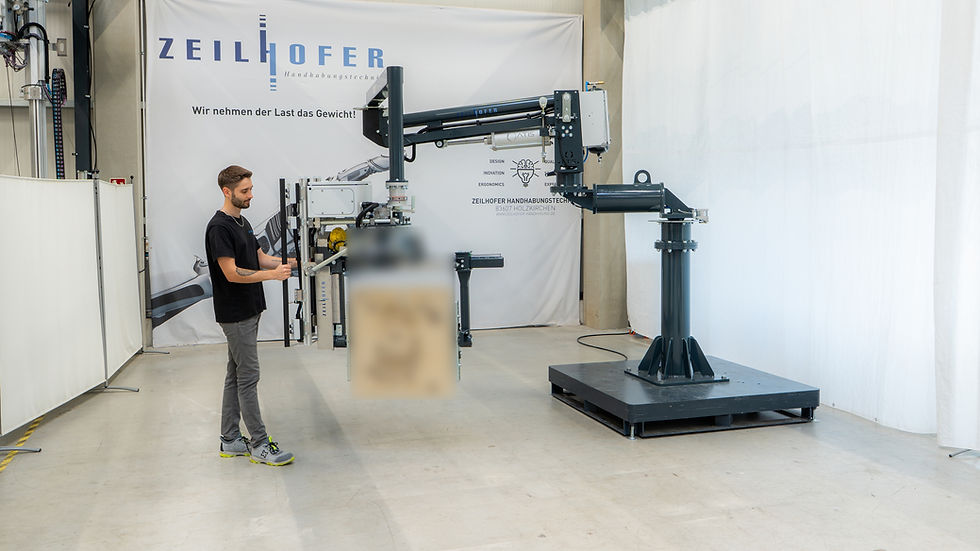
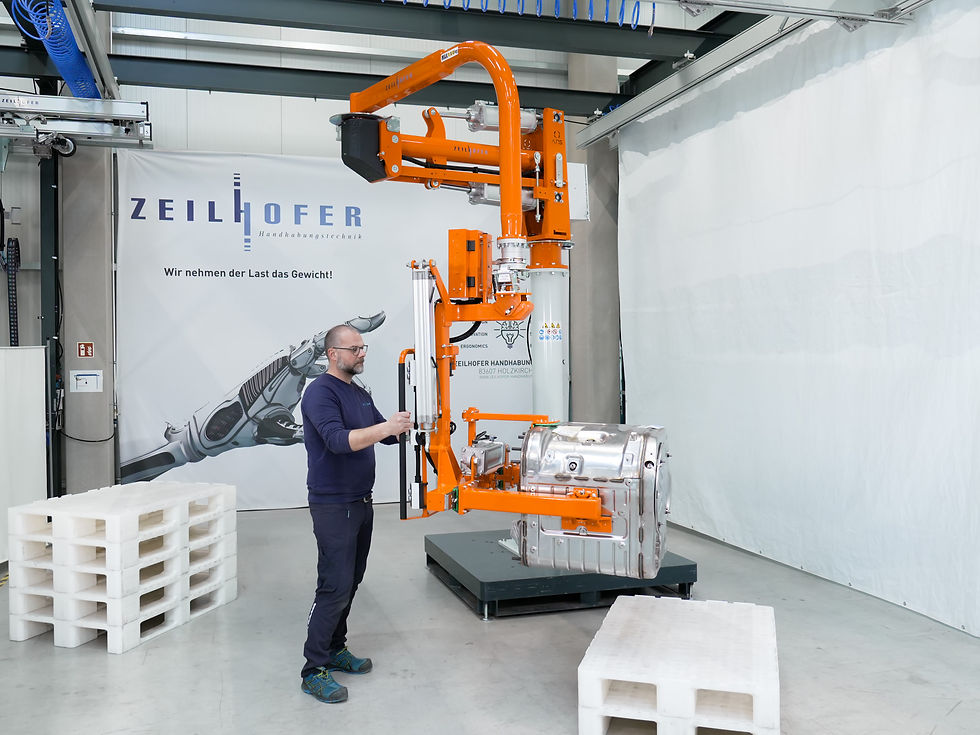
Assembling a trailer hitch in series production: cable manipulator and mobile lifting platform in continuous operation
A trailer hitch with crossmember weighs 25 to 35 kg and is bolted overhead to the rear of the vehicle during final assembly, often while the vehicle continues to operate. The most ergonomic installation is achieved using two coordinated devices: A pneumatic cable manipulator on the ceiling rail removes the hitch from the load carrier with a mechanical gripper, while an electric, mobile lifting platform brings it to the vehicle and holds it rigidly in position during bolting.
Zeilhofer Handling Technology from Holzkirchen designed this process chain for the final assembly of an automotive manufacturer, where additional vehicle models are integrated into an existing production line. This article illustrates the complete process, explains the division of roles between the two devices, compares the solution to cranes, robots, cobots, and exoskeletons, and provides a checklist for the design.
The most important points in brief
A trailer hitch with crossbeam weighs 25 to 35 kg and is handled many times per shift in an unfavorable position.
Division of roles: The rope manipulator removes and repositions, the ZH lifting lift adds rigidly and without pendulum movement to the vehicle.
The ZH lifting platform operates with a 48-volt battery, without cables, without compressed air on the line and without fixed installation on the floor.
An interchangeable load-bearing device makes the solution suitable for new vehicle derivatives.
The same technology works in the main line in continuous operation and in the upstream box production.
What is a trailer hitch and what does it consist of?
A trailer hitch, colloquially known as a towbar or trailer coupling, is the connecting device between the towing vehicle and a trailer or rear carrier. It essentially consists of three components: the crossmember, which is bolted to the body behind the bumper; the ball mount with the standardized 50 mm ball head; and the electrical kit with socket.
Depending on the vehicle and equipment, three types of construction are used:
Rigid towbar: The ball mount is permanently connected to the cross member.
Detachable towbar: The ball mount is inserted and locked when needed.
Swiveling towbar: The ball mount swivels manually or electrically under the bumper and is invisible when at rest.
The crossmember is crucial for handling. It is wide, bulky, and accounts for a large portion of the weight. Together with the ball hitch, a complete towbar weighs between 25 and 35 kg, and depending on the design, the center of gravity is not located in the middle of the component.
It is important to distinguish between the two: This article deals with factory assembly on the production line of an automobile manufacturer during series production. Retrofitting a trailer hitch in a car repair shop is a different process with different requirements.
Why the installation of trailer hitches is one of the most stressful tasks in final assembly
The assembly of trailer hitches combines a high component weight with a high repetition rate and awkward postures. This combination makes it one of the most critical stations in final assembly from an ergonomic perspective .
Weight and repetition rate: 25 to 35 kg per part, many times per shift, over years.
Awkward posture when removing the couplings: They are stored in boxes or cardboard containers. Anyone removing them by hand has to bend the torso far forward and tilt the part further when lifting it out.
Working overhead: The mounting points are located at the rear behind the bumper. The worker lifts the coupling to the bodywork with his arms above shoulder height.
Holding and screwing simultaneously: Without support, one worker must hold the load while a second person screws it in, or he holds and screws himself under full load.
Time pressure in continuous operation: The vehicle keeps moving. Every move has to be perfect.
Risk to the component: An uncontrolled impact will damage the painted bumper or the bodywork.
The consequences are measurable: Musculoskeletal disorders are among the most frequent causes of lost workdays in production. Our article "Musculoskeletal Disorders in Production" shows the concrete costs involved.
Legal framework and ergonomics assessment
In Germany, the Manual Handling Ordinance obliges employers to assess the hazards associated with manual handling and to implement appropriate measures. In practice, this assessment is carried out using the key indicator method, which combines load weight, frequency, posture, and working conditions into a risk score.
Several unfavorable factors coincide when mounting trailer hitches: a load weight in the range of 25 to 35 kg, a high repetition rate, and postures with a forward-leaning torso and raised arms. Our article "How many kg can you lift?" explains in detail how the assessment works and what the limits are.
From 2027, the EU Machinery Regulation will further tighten the ergonomic requirements for machinery and equipment. Whether lifting aids will become mandatory is answered in detail in our article "EU Machinery Regulation 2027: Ergonomic Obligations" .
The initial situation in the practical example
Several vehicle models are already in series production at the final assembly hall of an automobile manufacturer. Additional models are to be integrated into the existing line without impacting the availability of ongoing production or existing functions.
The specifications defined clear requirements for the handling equipment (HHG) and load-handling devices (LAM):
Integration into an ongoing production line with continuous operation, without any loss of plant availability.
Provision for further vehicle derivatives, therefore high importance of flexibility.
Load-bearing devices that can be easily and cost-effectively adapted for other products.
Two manufacturing principles: the main line in flow operation and an upstream offline production based on the principle of box production.
Planning, delivery, assembly and commissioning from a single source, based on the existing plant layout.
Coordination of timetable changes and steel construction modifications with the line planner commissioned by the customer.
Before submitting the bid, an on-site meeting was held in the hall. During this meeting, staging areas, ceiling heights, traffic routes, and existing equipment were recorded. It was clear from the outset that the layout could still change as the planning progressed. Therefore, the solution had to function independently of a fixed station position.
The solution: a process chain consisting of two devices
The solution divides the task into two steps with different requirements: the rapid removal and repositioning of the coupling, and its precise assembly on the vehicle. The device best suited for each step is used.
Removal: The worker guides the rope manipulator over the load carrier, grasps the attachment device with the mechanical gripper and lifts it out of the box with the necessary tilting motion.
Handover: The cable manipulator places the coupling onto the lifting platform of the ZH lift. The worker bears no weight during this process. If necessary, further work can be carried out on the coupling while it is on the lift before installation begins.
Transport: The worker pushes the ZH lifting platform to the vehicle by hand. Battery operation makes it cordless and independent of compressed air.
Assembly: At the rear, the lifting platform raises the coupling to the mounting points and holds it rigidly in position. The operator accompanies the vehicle during the continuous process and has both hands free for bolting.
Return journey: After the screws are tightened, the lifting platform lowers the empty receptacle and returns to the standby position.
Removal using the ZH70 rope manipulator on the ceiling rail
For unloading, Zeilhofer uses the ZH70 pneumatic cable manipulator , which runs on a ceiling rail. Cable manipulators balance the load via a pneumatic counterweight, making the coupling appear almost weightless. They are fast, smooth-running, and designed for loads up to 150 kg, thus offering ample capacity for trailer hitches.
The ceiling track offers two advantages: it covers the entire storage area with multiple load carriers, and it keeps the floor clear. Walkways, container exchanges, and vehicle flow remain unimpeded. No tolerance is required for assembly during removal and repositioning. This is precisely where the cable system demonstrates its strengths. The article " What is a cable balancer?" explains in detail how a cable system works.
The mechanical gripper for the trailer hitch
A mechanical gripper is attached to the cable, which securely engages the attachment device with the crossbeam. It operates without a vacuum and is therefore independent of the surface: foil, cardboard, corrosion protection, or slightly oily areas do not impair its grip.
The device can be moved and operated from all sides and from different positions. This allows the worker to grasp the coupling from a position that corresponds to its location in the load carrier.
The gripper is designed so that the operator can follow the tilting motion when lifting the load carrier out of the container. The coupling remains securely held and is only released once it is on the lifting platform. Further examples of component-specific mountings can be found on the page Devices and Grippers .
Joining with the electric lift ZH
The ZH electric lifting lift is used for joining components to the vehicle. It guides the load rigidly and without swinging , and can support up to 100 kg. This fulfills the requirement for joining components in final assembly: Swinging loads cannot be precisely positioned at the assembly points. More information can be found in the guide "Lifting Aids for Automotive Final Assembly" .
The ZH lifting platform is manually operated and powered by a 48-volt battery . It was the world's first platform lift with this type of battery. On the production line, it requires neither a power outlet nor compressed air nor a fixed anchor point. The operator pushes it to the vehicle, raises the coupling against the body, and accompanies the vehicle while bolting it in place. The guide "Lift Lift without Compressed Air " explains the advantages of battery operation, particularly on the production line.
Why two devices are better than one lifting aid
A single lifting aid would have to meet two conflicting requirements: high speed during removal and rigid precision during assembly on a moving vehicle. Separating the roles resolves this conflict of objectives.
A rope device alone would be ideal for extraction, but it swings during insertion and only reaches as far as the rail.
A jointed manipulator on a fixed column guides the vehicle without pendulum motion, but does not reach the moving vehicle along its entire path and requires space on the floor.
A lifting platform alone allows for precise insertion, but removing the item from the load carrier with a tilting motion would be cumbersome.
The combination utilizes the strengths of each device: speed and range from above, precision and mobility on the ground.
Which design is generally suitable for which task ? This guide compares articulated or cable manipulators.
Solutions compared: lifting aid, crane, robot, cobot and exoskeleton
There are generally six possible solutions for mounting trailer hitches. Handling technology, in which the person guides and carries the device, best combines relief, flexibility, and cost-effectiveness.
Manual lifting
Without aids, the worker bears the full weight in a constrained posture, often in pairs. At 25 to 35 kg and a high repetition rate, this is neither ergonomically acceptable nor process-reliable.
chain hoist or crane
A chain hoist lifts the weight, but it is slow, and the load swings on the hook. It lacks the precision for attaching loads to a moving vehicle and the speed for quick removal.
industrial robot
A robot can grip couplings, but requires safety devices, programming, and complex integration into the production line. Every new variant means reprogramming and often new grippers. For medium production runs and frequent model changes, this is rarely the most economical solution.
Cobot
Collaborative robots operate without safety barriers, but are limited in payload and speed. Many cobots reach their limits when handling 25 to 35 kg at the pace of a final assembly line. A detailed comparison is available in the guide "Manipulator or Cobot?"
exoskeleton
Exoskeletons provide support during overhead work, but they do not relieve the load. The person still carries the attachment themselves, and the precision of the assembly depends solely on them.
Handling technology with rope manipulator and lifting platform
The device bears the entire weight; the operator guides it by eye and hand. No programming is required, and new variants only need an adapted mount. The solution integrates seamlessly into existing lines without requiring any production modifications. The guide "Semi-Automated Handling" explains when semi-automated solutions are worthwhile.
Flexible for new vehicle derivatives
The solution is designed to grow with the model range. If a new derivative with a different coupling or crossbeam geometry is added, only the load-handling device is adapted, not the machine itself.
Interchangeable load handling device: The gripper on the rope manipulator and the mounting on the hoist are designed as interchangeable assemblies . A new geometry means a new mounting, not a new system.
No fixed station: The ZH lifting platform is not tied to a specific location. If the assembly position shifts during a changeover, it simply moves along with it.
Extendable ceiling track: If the storage area grows, the track can be extended.
Investment protection: The equipment remains in use even after model changes. Zeilhofer systems are designed for economical operation over 15 to 20 years .
Flow production and box manufacturing using the same technology
Box production refers to the assembly of vehicles at fixed workstations outside the main production line, for example for pre-production and test vehicles before their actual integration into the line. In this practical example, new models are initially assembled offline according to this principle before being moved to the main production line.
The cable manipulator and lifting platform function in both environments. In box assembly, the vehicle remains stationary while the lifting platform moves from box to box. On the main line, it accompanies the vehicle during continuous operation. The workers learn the process once and use it in both areas.
Especially in the pre-production phase, confidentiality is paramount. Zeilhofer is TISAX Level 2 certified with prototype protection and therefore qualified to work on and with prototypes. The article "What is TISAX?" explains what this entails.
Safety, testing and operation
Lifting aids used in series production must be safely designed, regularly inspected, and reliably maintained. Zeilhofer supplies all the necessary components from a single source.
Overload control: If the ZH lifting lift unexpectedly encounters excessive resistance during its upward or downward movement, such as a hand or the vehicle body, it detects this and stops.
CE conformity: Each system is delivered with a declaration of conformity and operating instructions.
Safety inspection: Lifting aids are inspected annually according to DGUV Regulation 54. The procedure and deadlines are explained in the guide "Safety inspection for lifting aids ".
Training: During commissioning, the workers on the line will be trained.
Service: Our service offers maintenance contracts, original spare parts and technical support.
Checklist: Lay out lifting aid for trailer hitch installation
These ten points provide a structured basis for designing a lifting aid for mounting trailer hitches. They also form the basis of every design discussion with our engineers.
Component weight: Weight of the complete trailer hitch including cross member and all variants.
Center of gravity: Location of the center of gravity for each variant, crucial for the gripper design.
Load carrier: cardboard, cardboard load carrier or reusable rack, including position of parts and removal angle.
Line type: flow operation or cycle operation, plus the question of whether offline or box production is added.
Ceiling height and supporting structure: space and load-bearing capacity for a ceiling track.
Energy on the line: Availability of compressed air and electricity at the supply and assembly point.
Variants and derivatives: Current and future geometries that the load-bearing device is intended to cover.
Walkways and space at the rear: path between the vehicle's storage area and the vehicle itself, free space under the bumper.
Operating concept: Operation by one person, controls on the handle , release logic.
Testing and maintenance concept: UVV testing, maintenance intervals, spare parts supply.
The guide " What does a manipulator cost?" explains what costs you will incur. The guide "Calculating the amortization of a lifting aid" shows how quickly a lifting aid pays for itself. As an alternative to investing, you can finance through leasing or hire purchase .
This is how a project with Zeilhofer works
From initial inquiry to operational plant, Zeilhofer provides comprehensive project support. Since 1999, the company has delivered over 2,500 plants to customers in more than 50 countries.
Specifications and on-site appointment: Recording of components, load carriers, lines and layout directly in the hall.
Concept: Design of device, gripper and holder, setup plan and price indication.
Design and manufacturing: Engineering and manufacturing in Holzkirchen, Germany, according to ISO 9001.
Preliminary approval: Test with the original component in the showroom in Holzkirchen or digitally via video.
Assembly and commissioning: Installation on the line, coordinated with line planners and steel construction, including training of the workers.
Service: UVV inspection, maintenance and spare parts throughout the entire service life.
Video: the complete process
The video shows the entire process in one pass: The worker guides the ZH70 cable manipulator over the cardboard load carrier, grips the trailer hitch with the mechanical gripper, and lifts it out of the box. He then places it on the lifting platform of the ZH lift, pushes the lift to the vehicle, and raises the coupling to the mounting points at the rear. There, it is bolted in place in a continuous process while the lift holds the weight.
Video content overview
In the video, Zeilhofer demonstrates both lifting aids on a heavy trailer hitch, which is then installed on the vehicle after removal. The key steps are:
0:12 Scenario: The trailer hitch is removed and then installed on the vehicle.
0:17 Removal: The ZH70 rope manipulator picks up the coupling in no time.
0:32 Operation: The device can be moved and operated from all sides and positions.
0:39 Storage: The worker guides the coupling to the ZH lift and places it there.
0:46 Intermediate step: Work can still be carried out at various points on the lifting platform before installation.
0:50 Overload control: If the hoist encounters excessive resistance while moving upwards or downwards, it stops.
1:09 Installation: The clutch is routed to the vehicle and installed.
1:15 Energy: A long-life battery powers the lift.
glossary
Towing device (AHK): Connecting device between vehicle and trailer, consisting of cross member, ball mount and electrical kit.
Cross member: Load-bearing component of the trailer hitch, which is screwed to the body behind the bumper.
Ball rod: Support for the ball head, designed to be rigid, removable or swiveling.
Handling device (HHG) : Device that carries and guides loads for humans, such as manipulators, lifting axles or hoists .
Load handling device (LHD): Component-specific gripper or receptacle that connects the workpiece to the handling device.
Flow operation: Assembly principle in which the vehicle moves continuously through the line.
Cycle operation: Assembly principle in which the vehicle stops at each station for a fixed cycle time.
Box production: Assembly of vehicles at fixed workstations outside the main production line, for example in pre-series production.
Load carrier: Container or rack in which components are delivered to the line, for example a cardboard load carrier.
Rope manipulator: A pneumatic lifting aid that balances the load while suspended on a rope.
Lifting device: Mobile lifting aid with rigid lifting guide, the ZH lifting device with a 48-volt battery.
Frequently Asked Questions
How heavy is a towbar with crossmember?
A complete towbar with crossmember and ball mount typically weighs between 25 and 35 kg. The crossmember accounts for the largest portion of the weight. Depending on the design—fixed, detachable, or swiveling—the center of gravity is not located in the middle of the component. This makes manual handling even more challenging.
How is a trailer hitch ergonomically mounted in series production?
The most ergonomic method uses two devices: A cable manipulator on the ceiling rail removes the coupling from the load carrier with a mechanical gripper. A mobile lifting platform then transports it to the vehicle and holds it rigidly at the mounting points while the worker bolts it in place. The person guides the process; the devices bear the weight.
Which lifting aid is suitable for mounting trailer hitches?
A cable manipulator is suitable for removal because it is fast and covers large areas. For assembly on the vehicle, a lifting aid with a rigid, pendulum-free guide, such as the ZH lifting lift, is appropriate. The ZH70 cable manipulator has a lifting capacity of up to 150 kg, while the ZH lifting lift has a capacity of up to 100 kg.
Why two devices instead of one lifting aid?
Removal and insertion have opposing requirements. Removal demands speed and reach, while insertion requires precision on a moving vehicle. A cable-based tool swings during insertion, and a stationary manipulator cannot reach the moving vehicle. This combination leverages the strengths of both devices.
Can the lifting platform move along with the vehicle during continuous operation?
Yes. The ZH lifting platform is manually movable and not tied to a station. The worker lifts the trailer hitch to the mounting points and accompanies the vehicle while bolting it in place. The lifting platform holds the load rigidly in position.
Does the ZH lifting platform require compressed air or a fixed installation?
No. The ZH lifting platform is powered by a 48-volt battery and requires neither compressed air nor a power outlet nor floor anchoring at the production line. This simplifies integration into existing lines and facilitates future cycle time adjustments.
What happens if the ZH lift encounters an obstacle?
The ZH lifting platform has an overload protection system. If it unexpectedly encounters excessive resistance while moving upwards or downwards, such as a hand or the vehicle body, it detects this and stops. This reduces the risk of crushing and damage to components and the vehicle.
How is the lifting aid adapted to new vehicle derivatives?
The gripper and receiver are designed as interchangeable load-handling devices. With a new coupling or crossbeam geometry, only the load-handling device needs to be adapted; the cable manipulator and lifting platform remain unchanged. This keeps the costs of model changes low.
Wouldn't a robot be more economical for assembling trailer hitches?
Rarely. A robot requires safety devices, programming, and complex integration into the production line. Every new variant means reprogramming. Handling technology also completely relieves the worker, requires no programming, and adapts to new models via a new mounting system.
Can a rope manipulator and a lifting platform be retrofitted into an existing line?
Yes. The ceiling track keeps the floor clear, and the battery-powered lift requires no permanent installation. During the planning phase, Zeilhofer coordinates the track, travel paths, and mounting positions with the production planner and the steel construction team. This minimizes disruption to ongoing production.
Will lifting assistance be mandatory from 2027 onwards?
From 2027, the EU Machinery Regulation will tighten ergonomic requirements for machinery and equipment. Whether this will create an obligation for your workplace depends on the risk assessment. You can find the detailed answer in our article on the EU Machinery Regulation 2027 .
Your application: Ergonomically mounting trailer hitches
Are you planning to integrate new models into an existing production line or looking to reduce the strain on a demanding assembly station? Send us the component, load carrier, and line type. Our engineers will design the ideal combination of equipment and load handling device. We respond to inquiries within 24 hours on weekdays.
More practical examples from vehicle production can be found in the guide "Handling Technology for the Automotive Industry ." Further applications from vehicle production include: handling car seats , handling car doors , tire and rim handling , and engine and transmission assembly . An overview of all 18 industries is available on the "Applications" page.