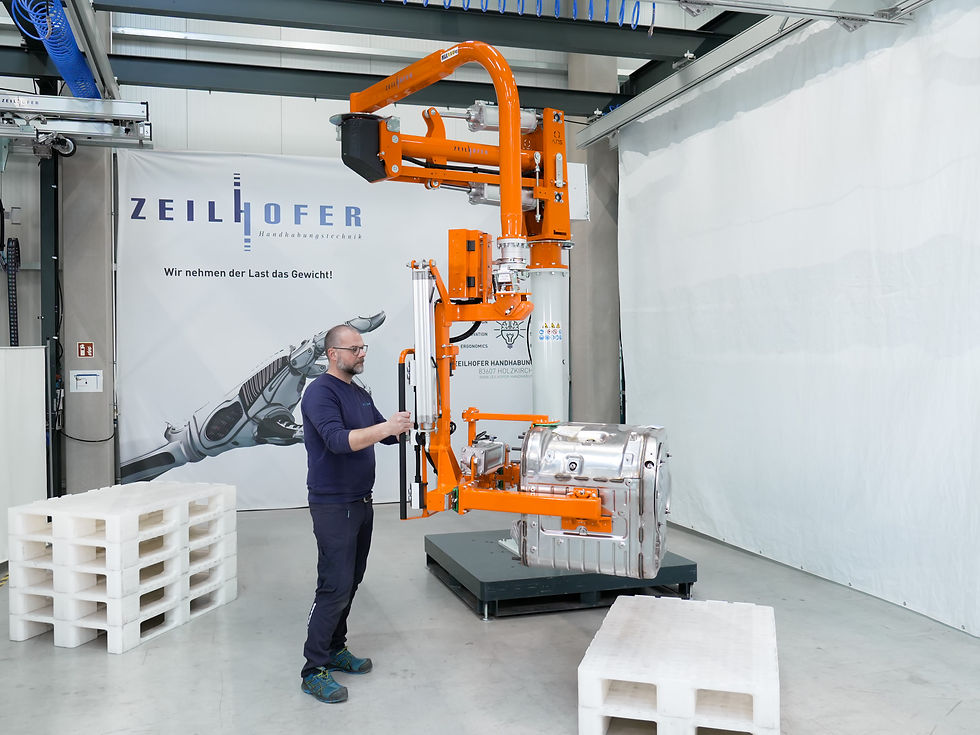
Sand core handling in the foundry: Manipulator with internal handle for cores up to 70 kg

Sand core handling is gentlest when the core is picked up from the inside through its bores. A pendulum-free articulated arm manipulator with two picking pins holds the sand core securely without clamping the delicate outer contour, completely relieving the operator of the weight.
Zeilhofer Handling Technology has developed such a solution for the core-making department of a foundry. There, nine different sand cores, weighing between 1.1 and 68.9 kg, are picked up, rotated, and inserted within a working radius of 3 m. This article shows how the picking process works, which data determines the design, and what foundries should consider when choosing a lifting aid for sand cores.
What is sand core handling?
Sand cores create cavities, channels, and undercuts in the casting. Before casting, they must be removed from the core shooting machine or the core supply, assembled into a core pack, or placed directly into the mold. All these steps together are referred to as sand core handling. The larger and heavier the cores, the more important a handling technique becomes that combines precision, component protection, and ergonomics.
Why sand cores require special handling
Sand cores consist of bonded molding sand. They are dimensionally stable, but sensitive at edges and surfaces. Even slight impact or excessive clamping pressure can cause chipping, which later reappears as defects in the casting. The result is rework, scrap, or in the worst case, a completely discarded core package.
A gripping solution for sand cores must therefore fulfill two requirements simultaneously: it must hold the core securely without stressing its outer contour. Conventional external grippers quickly reach their limits in this regard.
The starting point in the practical example: nine kernels up to 68.9 kg
In our customer's core shop, several sand cores with very different weights are produced for each casting:
Top core: 68.0 kg, must be turned 180 degrees before insertion.
Base core: 37.0 kg
Inner core 01: 37.0 kg
Side core 01 and 02: approximately 24.0 kg each
Frontal core: 22.0 kg
Sprue core: 14.0 kg
Inner core 02: 11.0 kg
Locking cores: 1.0 kg
The cores measure between 480 x 410 mm and 670 x 620 mm. Some are picked up from the side, others from above. Handling the fully assembled core package is not strictly necessary; the focus is on the individual cores.
From manual hole gripper to lifting aid
Previously, the cores were installed using a manual hole gripper. While this principle already engages gently in the core hole, the entire weight is borne by the operator. With cores weighing over 20 kg, numerous repetitions per shift, and the precise insertion into tight core holders, this is neither ergonomic nor reliable in the long run.
The task was therefore: to retain the proven gripping principle via the bore, but to transfer the weight completely to a lifting aid and additionally to enable the turning of heavy cores.
The solution: a recording device with an internal handle via the core hole.
The core component is a specially designed receiving device . Two receiving mandrels engage with the existing bushing holes in the core, either Ø 20 mm conical at a depth of 50 mm or Ø 40 mm at a depth of 65 mm, depending on the core. Rubber elements on the mandrels expand upon engagement and hold the core from the inside. High clamping forces from the outside are completely eliminated.
Depending on the geometry, the core is picked up from the side or from above. The article "Manipulator with Internal and External Handles" explains when an internal and external handle is suitable. A related spreading principle for roller cores is shown in the article "Manipulator with Interchangeable Spreading Mandrel" .
This is how inserting a sand core works.
Guide the manipulator over the provided core and align the receiving mandrels with the socket holes.
Insert the prongs; the rubber elements expand and hold the core from the inside.
Lift the core; the manipulator bears the entire weight.
Swivel the core towards the installation point and, if necessary, rotate it up to 180 degrees using a joystick.
Lower the core into the core bearing or core pack without it swinging.
Relax the rubber elements, pull out the prongs and pick up the next core.
Four axes of rotation: Turn cores without repositioning
To ensure that each core arrives in the correct position without repositioning, the manipulator has four axes of rotation:
Main axis: manually rotatable 360 degrees continuously
Boom arm: manually rotatable by 300 degrees
Mounting device: manually rotatable through 360 degrees
Gripper: pneumatically rotatable by 180 degrees, infinitely variable via joystick control
This also allows the 68.9 kg deck core to be turned over in a controlled manner and placed down precisely, without the employee having to hold or support it.
Technical specifications at a glance
Core weights: 1.1 to 68.9 kg
Working radius in relation to the component: 3,000 mm
Stroke range: 260 to 1,200 mm lower edge of component
Interference contour: 3,100 mm lower edge of crane hook
Mounting: two prongs with expanding rubber elements, from the side or from above
Installation: on a stable base plate, without ground anchoring
Movement: pendulum-free, gripper rotation pneumatically controlled via joystick
External gripper, hole gripper or manipulator with internal handle: a comparison
In practice, three approaches are possible for sand cores, which differ significantly in component protection and load-bearing capacity:
External gripper or tongs: quick to implement, but high clamping pressure on the core surface and therefore an increased risk of chipping.
Manual hole gripper: protects the outer contour, but the full core weight rests on the employee; heavy cores are difficult to turn.
Manipulator with internal handle: protects the outer contour, bears the entire weight, enables rotation and millimeter-precise insertion
Why an articulated arm manipulator and not a crane?
Sand cores are often picked up laterally, and therefore off-center. A crane or chain hoist swings, and this swinging motion causes them to hit edges during insertion. An articulated arm manipulator absorbs the moments from the off-center load and remains stationary in any position. The differences are explained in the guide "Manipulator, Crane or Chain Hoist: What for What?" , and the choice of the appropriate system is explained in the guide "Articulated or Cable Manipulator ".
For purely vertical lifting tasks with heavy loads, the ZH90 lifting axis is an alternative; it lifts up to 1,200 kg. An example of this is the lifting axis with a clamping device for sand cores .
Ergonomics and occupational safety in core making
Lifting weights between 20 and 70 kg, many repetitions per shift, plus twisting and precise positioning in a stooped position: This is a classic workload situation according to the German Manual Handling Regulations. The article "How many kg can you lift?" shows where the limits lie. The article "Musculoskeletal Disorders in Production " calculates what sick days due to back problems actually cost a company.
The employee only guides the core using the manipulator. Experience and dexterity in core placement remain with the human; the technology takes care of the weight.
What matters when designing sand cores
Every core-making facility works with different cores and processes. For a reliable design, we primarily need:
Core list with weight and dimensions per core
Location, diameter and depth of the receiving bores
Shooting direction (side or top) and required rotations
Working radius, lifting range and interfering contours such as crane runways or hall columns
Cycle time and number of cores per layer
Installation location: Base plate, floor anchoring or ceiling mounting
From the core list to the first inserted core
Analysis: We evaluate the core list, bore pattern and installation location and determine which cores can be accessed with a common device.
Design: You will receive a concept for the manipulator, mounting mandrels and rotary axes with an initial price indication.
Construction: Design and manufacturing in Holzkirchen, certified according to ISO 9001 and TISAX Level 2 with prototype protection
Handover: Setup, employee training and commissioning directly at your foundry, with regular safety inspections upon request.
Since 1999, Zeilhofer Handling Technology has delivered over 2,500 systems for 18 industries. Further solutions for foundries include the manipulator for molding boxes and the ZH90 lifting axis in foundry operations . All industries can be found in the application overview .
Frequently asked questions about sand core handling
What is meant by sand core handling?
Sand core handling refers to the picking up, transporting, rotating, and inserting of sand cores in the foundry, for example, when assembling a core package or placing it into the mold. The aim is to move the delicate cores without damage and without physically overexerting the employees.
How do you handle sand cores without damaging them?
The gentlest method is through existing core holes from the inside. Receiving mandrels with expanding rubber elements hold the core without clamping the delicate outer contour. A pendulum-free manipulator further prevents impact and chipping during insertion.
What is the difference between a hole gripper and a manipulator with an internal handle?
A manual core gripper also engages the core hole, but the operator bears the weight. With a manipulator featuring an internal handle, the lifting aid takes over the entire weight; the operator only guides the core.
From what core weight does a lifting aid become worthwhile?
Even kernels weighing around 15 to 25 kg put considerable strain on the back when lifted frequently; heavier kernels are almost impossible to insert precisely without aids. The assessment is carried out according to the Manual Handling Regulations and the key indicator method.
Can a manipulator rotate or turn sand cores?
Yes. In practical use, the gripper rotates pneumatically and continuously by 180 degrees via joystick, while the holding device can also be manually rotated by 360 degrees. This allows, for example, a 68.9 kg deck core to be turned safely.
Which manipulator is suitable for sand core handling?
For lateral lifting and precise placement, a pendulum-free articulated arm manipulator is suitable. For purely vertical lifting tasks with heavy loads, the ZH90 lifting axis is an alternative.
Can one device accommodate different sand cores?
Yes, if the cores have comparable bore sizes. In this practical example, the device accommodates two bore sizes, Ø 20 mm conical and Ø 40 mm, and accepts the cores from the side or from above.
Does the manipulator need to be anchored in the hall floor?
Not necessarily. In the practical example, the manipulator stands on a stable base plate and can be set up without ground anchoring and moved if necessary.
How much does a sand core manipulator cost?
It depends on the load, working radius, axes of rotation, and device. Simple cable manipulators start at around €10,000, while complex solutions cost significantly more. The guide "What does a manipulator cost?" provides an overview.
Further topics from the blog and guide
How to handle sand cores more safely and ergonomically?
Send us your core list with weights and pickup points. We will check which cores can be covered by a device and get back to you within 24 hours on weekdays.
Zeilhofer Handling Technology, Holzkirchen: Manipulators and lifting aids up to 1,200 kg , developed and manufactured in Germany.