Lifting aid for mountain carts: How a manipulator makes loading easier on the chairlift
When a task is repeated hundreds of times a day, a small movement quickly becomes a considerable physical strain. This was precisely the challenge faced by the Spitzingsee Alpine Railways when loading their mountain carts at the Stümpflingbahn chairlift. On a typical operating day, employees have to pick up a cart and attach it to the chairlift up to 400 times; on peak days, this number can reach 600 times. Each cart weighs between 20 and 30 kilograms, depending on its size.
In Germany, the Manual Handling Ordinance regulates how much weight is generally considered acceptable for manual lifting; more information can be found in the article "How many kg can you lift? Limit values and the key indicator method ". Our guide "Industrial Lifting Aids " provides an overview of all types of lifting aids. The existing homemade solution was no longer sufficient for summer operations at the mountain station.
A task that many mountain railways are familiar with.
Mountain carts offer guests a summer experience on two wheels. For the staff behind them, however, operating them primarily means one thing: the carts must be constantly prepared, moved to the lift station, and attached to the chairlift so they can be transported back uphill.
At the Spitzingsee Alpine cable cars, this task was initially eased with a custom-built solution, which halved the perceived weight of the carts. However, with up to 600 handling operations on a peak day, this was no longer sufficient to provide lasting relief for employees.
From the initial measurement to the perfectly fitting lifting aid
A lifting aid for mountain carts cannot be an off-the-shelf product. Every mountain station has its own geometry, and every loading zone on the chairlift has its own installation space.
At the Spitzingsee Alpine lifts, the loading zone is located beneath the lift station in a clearly defined corridor approximately three meters high and three meters wide. Within this space, the entire process, from picking up the cart on the ground to inserting it into the receiver on the chairlift, had to be carried out safely without disrupting the existing loading process.
Together with the on-site operations management team, the actual distances were measured directly at the system: the hook position on the cart, the required lifting height for transfer to the chairlift, and the available space in the loading zone. Only on this basis was the precisely fitting receiving device, including the hook, created, which fits perfectly into the existing workflow at the mountain station.
Simply hook it up, the manipulator does the rest.
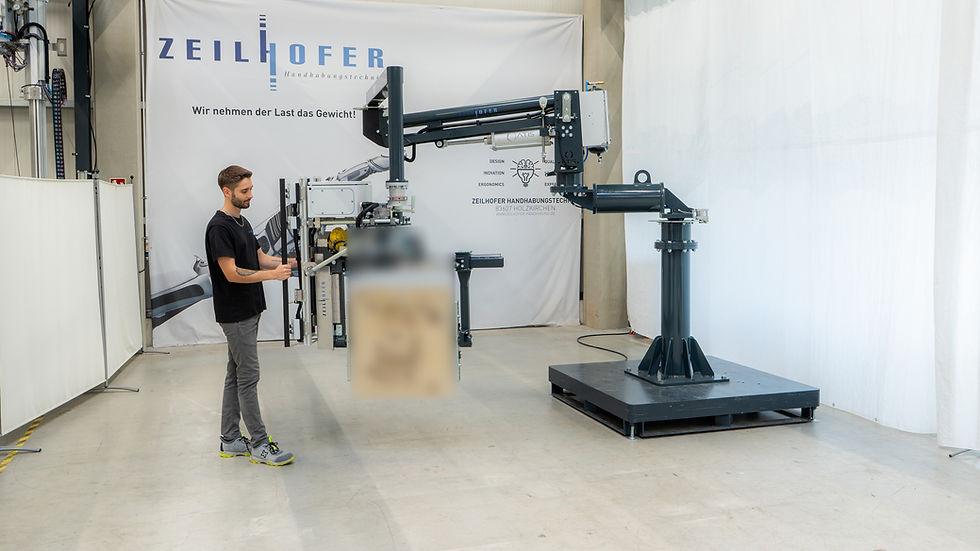
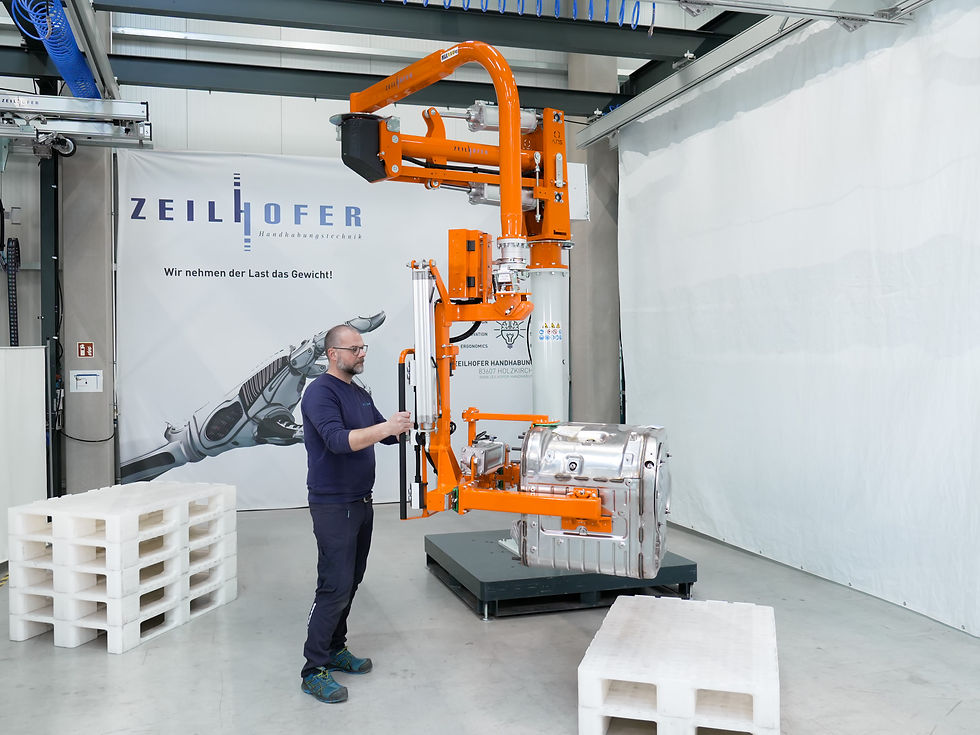
The process for employees is deliberately kept simple. The cart, which is standing on the ground, is hooked into the lifting device. From this moment on, the manipulator takes over the entire weight and lifts the cart, suspended in mid-air, to the height of the handover position at the chair.
The operator now only guides the movement; they no longer carry it. The cart is precisely aligned and transferred to the chair, after which the manipulator returns to its starting position for the next operation.
A physically demanding lifting process thus becomes a controlled, repeatable movement sequence that can be reliably performed even with several hundred repetitions per day.
Less effort, more safety: the advantages at a glance
significantly less physical effort required when hooking up
Lower risk of overuse injuries with high repetition rates
Consistently safe and precise positioning on the chair
Shorter cycle times per cart, especially on peak days
simple, intuitive operation without lengthy training.
A more predictable, ergonomic workday for employees
A task that extends far beyond Spitzingsee
Mountain carts are no longer a niche product. According to manufacturers, over 150 stations worldwide operate their own mountain cart fleets, from the Alps to Scandinavia and Japan. The core task is the same everywhere: carts must be provided, transported, and transferred to chairlifts or conveyor belts, often several hundred times a day.
What was developed as a customized solution for the Stümpflingbahn cable car at Alpenbahnen Spitzingsee can, in principle, be applied to this task: to other mountain stations, other cart models, and other loading situations. Crucially, as with all our projects, the manipulator and loading device must be precisely tailored to the specific system.
Handling technology that fits into everyday work life
A good handling solution is not characterized by the use of as much technology as possible. What is crucial is that it noticeably supports employees in their daily work.
At Zeilhofer Handling Technology, we develop manipulators and lifting devices for a wide variety of industries: from the automotive sector and food production to, as in this project, the cable car and leisure industry. Our focus is never on a standard product, but rather on the specific task within each work process. This project also demonstrates how our cable manipulator moves loads smoothly and without pendulum swing: the lifting device was custom-designed for attaching the mountain carts.
Because modern handling technology doesn't just move loads. It relieves the people behind it of some of the daily strain.

Frequently asked questions about the lifting aid for mountain carts
How does a lifting aid work when attaching mountain carts to the chairlift?
The employee hooks the mountain cart into the mounting device; the manipulator takes over the weight and guides the cart, suspended in mid-air, to the transfer position at the chair. The operator only controls the movement, not the weight.
How much do mountain carts weigh and how often do they need to be lifted daily?
Depending on their size, mountain carts weigh between 20 and 30 kilograms. At the Spitzingsee Alpine cable cars, up to 400 handling operations occur on a normal operating day, and up to 600 on peak days.
What role does the available construction space at the lift station play?
The loading zone under the lift station is often very limited. At the Spitzingsee Alpine lifts, a corridor approximately three meters high and three meters wide was available, within which the entire process, from picking up the passengers to transferring them to the chairlift, had to take place.
Can a lifting aid for mountain carts also be adapted for other cable car or leisure facilities?
Yes. Since each mountain station, loading zone, and cart type is structured slightly differently, the loading device is individually designed. Currently, over 150 stations worldwide operate mountain cart fleets, and the operating principle can be applied to many of them.
What distinguishes the new lifting aid from the previous in-house solution of the Spitzingsee Alpine Railways?
The previous in-house solution reduced the perceived weight of the carts by about half, but was no longer sufficient for up to 600 handling operations on peak days. The new lifting aid completely takes over the weight of the cart, so that employees only have to control the movement and no longer have to carry it themselves.
Who develops and builds the lifting aid for mountain carts?
The lifting aid is individually designed and manufactured by Zeilhofer Handling Technology in Holzkirchen, from the initial on-site measurements to the fully operational system.
Does a lifting aid for mountain carts need to be inspected regularly?
Yes. Like any lifting aid, a system for mountain carts is subject to annual accident prevention inspections according to DGUV Regulation 54. More information can be found in the guide: Accident Prevention Inspection for Lifting Aids .
Want to make your mountain cart or chairlift loading more ergonomic?
Do you operate a mountain railway or amusement park with mountain carts or similar vehicles that are manually attached to a lift or transport point every day? Our engineers will develop a customized lifting aid for you, from the initial on-site measurements to the finished system. Made in Germany, all from a single source.
Our guide offers more background information on ergonomic handling technology.