


ZH90 lifting axis with vacuum device lifting a glass pane in production
ZH90 lifting axis with vacuum device lifting a glass pane in production
Guide · Glass and Windows
Manipulator for glass panes and windows
Glass manipulator and lifting aid for glass: Safely lift, rotate, tilt and glaze glass panes, insulating glass and window elements in production.
Short answer
For glass panes and windows in production, manipulators, also called glass manipulators or glass lifting aids, with vacuum, gripping, or combined devices are suitable. A Zeilhofer articulated manipulator lifts up to 800 kg, while the ZH90 lifting axis lifts up to 1,200 kg. The rigid guide prevents oscillation, allowing panes to be positioned, rotated, tilted, and glazed with millimeter precision. Glass weighs approximately 2.5 kg per square meter and millimeter of thickness. This guide shows you how to calculate the weight, choose the right system, and properly design the safety features.
The guide "Vacuum Tube Lifter Alternative" explains in detail how vacuum safety works.
The most important points in brief
This refers to solutions for production, window manufacturing and insulating glass, not vacuum lifters for construction sites.
Glass weighs approximately 2.5 kg per m² and mm thickness; insulating glass 4/4/4 with 2.0 × 1.5 m weighs around 90 kg.
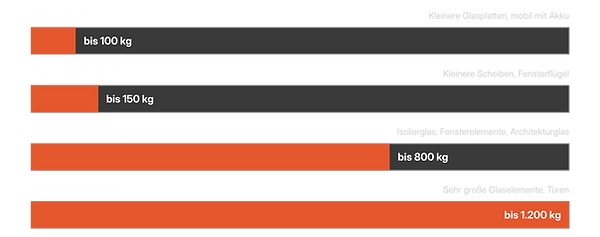
Lifting lift ZH up to 100 kg (mobile), rope manipulator up to 150 kg, articulated manipulator up to 800 kg, lifting axis ZH90 up to 1,200 kg, each including device.
Suction, gripping, or a combination of both; the combination offers maximum safety.
Rotating, swiveling, tilting and glazing are implemented according to customer requirements.
Two separate vacuum circuits and pressure monitoring keep the disc in place even in the event of a fault.
CHAPTER 1
Why glass handling is a special challenge
A pane of glass behaves differently than a steel component of the same mass. It has a large surface area, breaks under point loads or edge impacts, and has surfaces that are susceptible to damage from coatings, films, or solar control layers. At the same time, its weight increases with every millimeter of thickness and with each additional pane in the structure.
Manually moving large panes of glass, insulating glass units, or finished window elements requires two to four people, risks glass breakage, and puts strain on the back and shoulders. A manipulator transforms this team task into a single-person job: the load is guided almost weightlessly, and the operator determines its position and orientation with minimal effort. This guide focuses on solutions for production, window manufacturing, and insulating glass production, not vacuum lifters for construction sites.
CHAPTER 2
Calculating glass weight: the rule of thumb
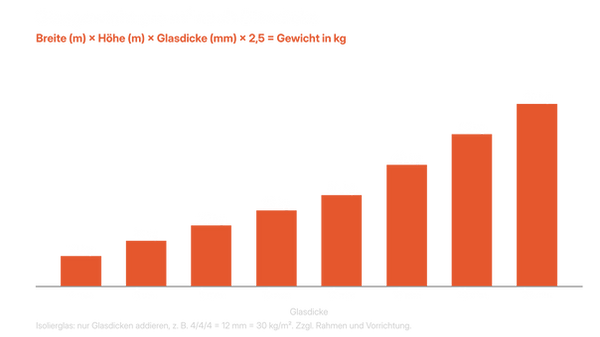
Float glass has a density of approximately 2,500 kg per m³. This results in a simple rule of thumb: Weight in kg = Width in m × Height in m × Glass thickness in mm × 2.5. For insulating glass, only the glass thickness matters, not the space between the panes.
-
Triple insulating glass 4/4/4, 2.0 × 1.5 m: 3.0 m² × 12 mm × 2.5 = approx. 90 kg
-
Large format insulating glass 6/6/6, 4.0 × 2.5 m: 10 m² × 18 mm × 2.5 = approx. 450 kg
-
Architectural glass LSG 2 × 10 mm, 3.21 × 2.5 m: 8.0 m² × 20 mm × 2.5 = approx. 400 kg
The design doesn't just depend on the glass. The load-bearing capacity of a manipulator always applies to the component plus the fixture. Include the frame, fittings, and the weight of the suction or gripping device, and plan for the heaviest format that will be manufactured in the future.
CHAPTER 3
Which system is suitable for which glass weight?
The choice of basic system depends primarily on the overall weight, the reach, and the required movements. Zeilhofer offers four systems for glass and windows, each with its own individual device:
-
Lifting platform ZH up to 100 kg: mobile movement of smaller glass plates, battery-operated, without crane and without compressed air
-
Cable manipulator up to 150 kg: smaller panes and window sashes, predominantly vertical lifting
-
Articulated manipulator up to 800 kg: insulating glass, window elements and architectural glass, rigidly guided with rotation and tilting.
-
Lifting axis ZH90 up to 1,200 kg: very large glass elements and doors, linearly guided and integrable into lines
Which system for which glass weight:
.png)
Which system is suitable in each individual case also depends on working height, cycle time, and available space. Mounting options and the reach of the articulated arm are shown in the guide "Articulated Arm Manipulators up to 800 kg ," while the mobile solution is described in the article "Mobile Lifting Aid for Panels ." What to consider when choosing a manufacturer is explained in the guide "Selecting a Manipulator Manufacturer ."
CHAPTER 4
Suction, grasping, or a combination of both?
The device determines whether glass is picked up safely and gently. Zeilhofer designs them individually for each component. The article "What is a suction device?" explains how a vacuum is maintained in principle.
Suction (vacuum)
Here's how it works
Suction cups hold the disc flat using negative pressure.
Suitable for
Smooth single panes, insulating glass, PV modules
Advantage
No contact with edges, adjustable suction cups for changing formats.
surface
Gentle suction cups also suitable for coated glass and mirrors
Security
Two separate vacuum circuits with pressure monitoring
Gripping (mechanical)
Here's how it works
Grippers hold the element securely against the frame or edge.
Suitable for
Finished window elements with frames, front and patio doors
Advantage
Regardless of surface and density
surface
Soft pads protect edges and frames
Security
Holds without energy for the vacuum
Combined: For large and heavy elements, tilting, and glazing, Zeilhofer combines both principles. The vacuum holds the pane, while the gripper provides additional form-fitting security. This ensures the load remains secure even if the vacuum is lost.
CHAPTER 5
Rotating, swiveling, tilting and glazing
In glass and window production, simply lifting is rarely sufficient. All movements are implemented according to customer requirements, either manually guided or motorized.
Tilt by 90°
Receipt lying down from the table or roller conveyor, storage standing upright in the A-frame or transport rack.
Rotation in the plane
Rotate portrait format to landscape format, for example for alignment before glazing or edge processing.
Sway
Swivel the load around the column or arm to operate multiple stations from one workstation.
Glazing
Insert the disc into the frame with millimeter precision. The rigid guide holds the position; the worker aligns it.
CHAPTER 6
Safety: What a glass manipulator must be able to do
When glass is placed near or above people, safety is of paramount importance. Zeilhofer vacuum devices are therefore equipped with multi-stage safety features:
01
Two separate vacuum circuits
If one circle fails, the second one continues to hold the disc securely.
02 Pressure monitoring
The vacuum is constantly monitored. The load is only released when a sufficient vacuum is achieved.
03
Stop upon pressure loss
If the negative pressure drops, the system warns and stops the movement.
04
Mechanical positive locking
Optionally, grippers can be used to secure the load additionally, independently of the vacuum.
The guide "Vacuum Tube Lifter Alternative" explains why a guided manipulator with a vacuum device has advantages in terms of safety and positioning accuracy compared to the classic vacuum tube lifter.
CHAPTER 7
Manipulator or vacuum lifter on the crane.
Many companies lift glass using a vacuum lifter attached to a chain hoist or crane. This works, but reaches its limits in mass production. The difference lies in the way the load is guided.
manipulator
guide
Rigidly guided, the disc does not swing.
Positioning
Precise to the millimeter, even when glazing
Off-center loads
are recorded instantaneously
staff
One person instead of two to four
Suitable for
Permanent jobs and series production
Vacuum lifter on the crane
guide
It hangs from a rope or chain and swings.
Positioning
It takes time and often a second person.
Off-center loads
Tend to hang crooked
Requirement
A crane or chain hoist must be available.
Suitable for
Changing locations, construction site, small quantities
For a general comparison of lifting systems, regardless of the material, please see the guide "Manipulator, Crane or Chain Hoist?" .
CHAPTER 8
Applications in the glass and window industry
Glass is not only used in window construction. Typical tasks for which Zeilhofer has implemented solutions include:
-
Window construction: Glazing, moving and stacking on transport racks of plastic and wooden windows, house, balcony, sliding and patio doors as well as prefabricated elements
-
Insulating glass: Insert panes into the edge seal and form stacks.
-
Architectural and facade glass: Handling large formats up to 6 m in length before and after cutting, grinding and coating systems
-
Photovoltaics: Transferring modules weighing 18 to 35 kg between the laminator, frame and junction box station
-
Mirrors and furniture glass: moving sensitive surfaces without leaving marks
-
Vehicle glazing: Installation of windshields, glass roofs and train windows
Selected practical examples:
An overview of all 18 industries can be found under Applications .
CHAPTER 9
Practical example: 13 solutions for a leading window manufacturer
Zeilhofer has been collaborating with a leading window manufacturer since 2008. During this time, 13 customized handling solutions have been developed, ranging from glazing and moving finished window elements to loading transport racks. At these stations, a single person now lifts where previously a team was needed. You can read the detailed practical example in the article "Lifting Aids for Window Production ."
CHAPTER 10
Costs and financing
The price comprises the basic system and the attachment. A simple cable manipulator starts at approximately €10,000, excluding installation and commissioning. Solutions for glass with vacuum or combined attachments, tilting and rotating functions cost more, depending on the requirements; complex lifting axis solutions can reach up to approximately €150,000. The cost drivers are explained in the guide "What does a manipulator cost?" . Instead of a one-time payment, leasing and hire purchase are possible through Würth Leasing; all details can be found in the guide "Leasing and financing lifting aids" .
CHAPTER 11
Checklist: Your request needs this information
With this information, you will receive a reliable assessment and a fixed-price offer more quickly:
-
Largest and smallest format as well as glass construction or glass thickness
-
Maximum weight including frame and fittings
-
Surface: Float glass, coated, foiled or framed
-
Storage and placement: lying down, standing up, rack, frame or roller conveyor
-
Required movements: rotating, swiveling, tilting, glazing
-
Working heights, reach and available space
-
Quantity per shift as well as photos or drawings of component and workplace
FAQ / Q&A
Frequently asked questions about glass manipulators
01 What is a glass manipulator?
A glass manipulator is a lifting aid that uses a suction, gripping, or combined device to pick up and rigidly move glass panes, insulating glass units, and window elements. The operator lifts, rotates, tilts, and positions the load with virtually no effort and without any swinging, instead of having to carry it by hand with two or four people.
02 How heavy is a pane of glass?
Glass weighs approximately 2.5 kg per square meter and millimeter of thickness. A 10 mm thick pane weighs about 25 kg per m². For insulating glass, only the glass thicknesses are added together: A triple glazed unit (4/4/4) measuring 2.0 × 1.5 m weighs approximately 90 kg.
03 Which manipulator is suitable for glass panes and windows?
For window construction and insulating glass manufacturing, an articulated manipulator with a vacuum or combined device is usually the first choice. For smaller panes up to 150 kg, a cable manipulator suffices, while for heavy glass elements up to 1,200 kg, the ZH90 lifting axis is used. Glass panels up to 100 kg can also be moved using the battery-powered ZH lifting platform.
04 Up to what weight can glass panes be lifted with a manipulator?
Zeilhofer articulated manipulators lift up to 800 kg, the ZH90 lifting axis up to 1,200 kg. The load capacity includes the attachment; the weight of suction cups or grippers is included.
05 Vacuum or gripper for glass: which is better?
Vacuum gripping is suitable for smooth panes and insulating glass without edge contact, while mechanical gripping is suitable for window elements with frames. The combination of both offers maximum safety because the load is held securely even if the vacuum is lost.
06 What happens in the event of a vacuum loss?
Zeilhofer vacuum devices operate with two separate vacuum circuits and continuous pressure monitoring. If one circuit fails, the second holds the pane in place. If the vacuum drops, the system issues a warning and stops the movement.
07 Can a manipulator rotate and tilt glass panes?
Yes. Rotation, swiveling and tilting are implemented according to customer requirements, for example, picking up a pane horizontally and inserting it vertically into the frame.
08 Manipulator or vacuum lifter on the crane: What is the difference?
A vacuum lifter on a crane or chain hoist hangs from a rope and swings. A manipulator guides the load rigidly and without swinging, takes off-center loads without tilting and allows millimeter-precise positioning by one person.
09 Is a glass manipulator suitable for the construction site?
Zeilhofer solutions are designed for production workplaces, such as in window manufacturing, insulating glass production, or assembly. Vacuum lifters mounted on cranes are common for use on changing construction sites.
10. How much does a glass manipulator cost?
Simple cable manipulators start at approximately €10,000 excluding installation. Solutions for glass with vacuum or combined devices cost more, depending on requirements, while complex lifting axis solutions can reach up to approximately €150,000. Leasing and hire purchase options are available through Würth Leasing.
READ MORE
FURTHER GUIDES ON THIS TOPIC

SECURITY
Vacuum tube lifter alternative

COST
How much does a manipulator cost?
