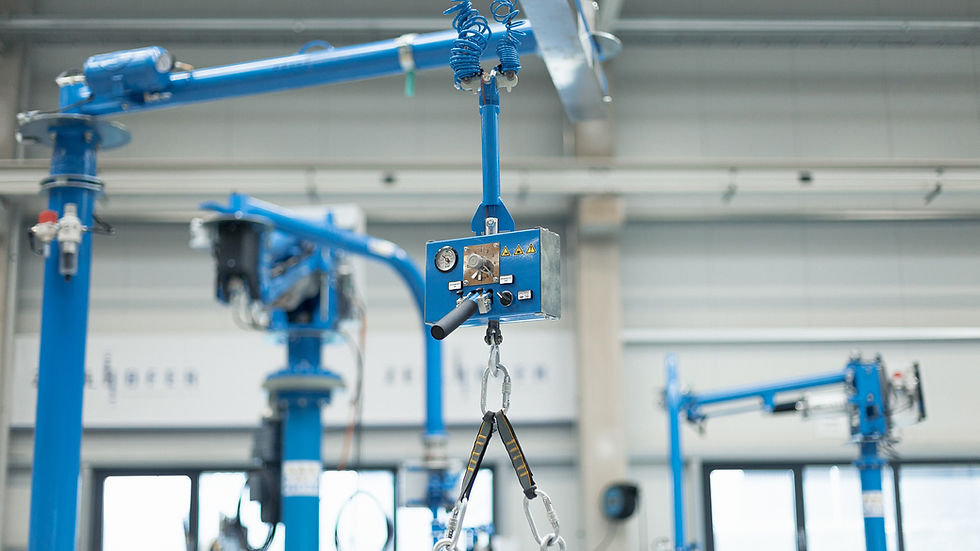
What is a suction device?
The name says it all: Our suction devices work with suction cups – these allow products or components to be safely picked up, lifted, and moved with ease. Gentle on the material. Safe for people.
What makes our suction devices so special?
🔧 They can be adapted precisely to your requirements – flexibly and individually.
🛡️ They move sensitive components particularly gently – without pressure points or damage.
💪 Built from sturdy, durable components – for tough, continuous use.
😊 And thanks to well thought-out operation: simple, safe, efficient.
Suction device, vacuum lifter, suction lifter: the terms
A suction device – also called a vacuum gripper, vacuum lifter or suction lifter – picks up loads gently using negative pressure. Instead of clamping the part mechanically, the cup creates a vacuum between the suction surface and the workpiece, so smooth, sensitive or coated surfaces can be lifted safely without damage.
How a suction device works
A vacuum generator – pump or ejector – lowers the pressure under the suction plate. Atmospheric pressure presses the part against the cup, and the resulting holding force carries the load. Area suction cups spread the force; single cups grip at points. An integrated load safeguard holds the part even during a brief pressure drop.
Typical applications for vacuum handling
Suction devices are ideal for glass panes and windows, sheet metal, panels, cardboard and coated parts. Combined with a manipulator or a ZH90 lifting axis, the operator moves heavy, bulky loads pendulum-free and to the centimetre.
What is the difference between a suction device and a vacuum lifter?
Both use negative pressure. A vacuum lifter usually refers to the complete lifting device, while a suction device is the load-side attachment that sits on a manipulator or lifting axis.
How heavy can a suction device lift?
Depending on the suction area and vacuum, from a few kilograms to several hundred kilograms. The surface, tightness and weight of the part are decisive.