Manipulator crane robot comparison: Which lifting solution is right for production?
Updated: Jul 21
Manipulator, crane, or robot? These three technologies seemingly solve the same task—moving loads—in fundamentally different ways. The manipulator guides the load precisely and without swaying, the crane allows it to swing freely, and the robot operates fully automatically. Which solution is suitable for which application depends on the load range, precision requirements, component variance, and degree of automation.

Manipulator: precise lifting with guided mechanics
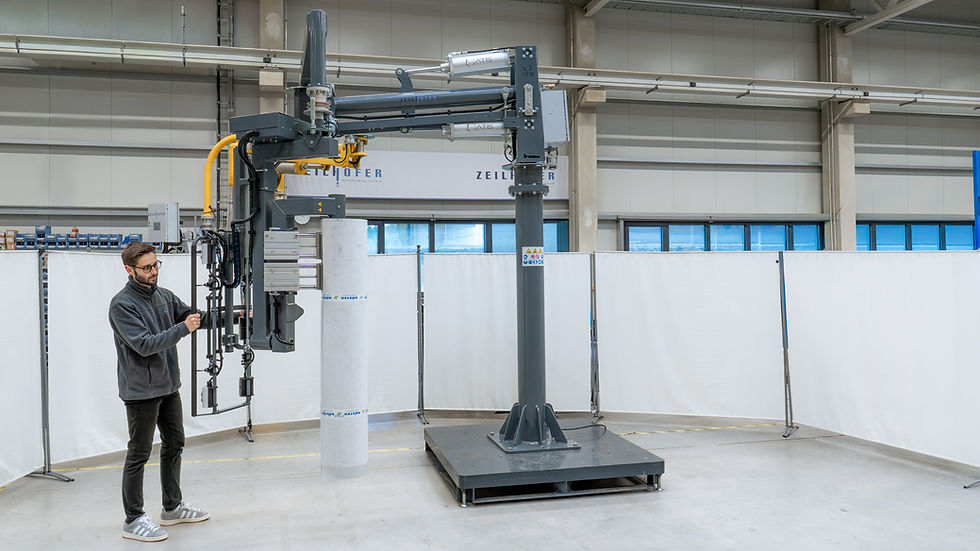
A manipulator guides the load smoothly along a rigid mechanism. The operator moves the component intuitively by hand; the system absorbs the weight and eliminates unwanted vibrations.Hub axle ZH90lifts up to 1,200 kg on the linear Z-axis,Joint manipulatorsunlock diverse processes up to 800 kg.
Strengths: oscillation-free load guidance, precise positioning in the millimeter range, intuitive operation, quick component changeoverQuick-change grippers and devices.
Crane: high lifting capacity, freely swinging load
The industrial crane lifts very heavy loads, from one ton to well over 50 tons. The load hangs from a cable and swings freely. This is ideal for transport and free lifting, but quickly becomes unsuitable for precise positioning with tight tolerances.
Strengths: highest load capacity, large lifting heights, established concept for heavy-load transport. Weaknesses: no precise positioning, high training and safety requirements for operation.
Robots: fully automated with consistent processes
Industrial robots execute movements fully automatically along programmed paths. This is economical for consistent components and high production volumes, but less so for frequently changing geometries or manual guidance.
Strengths: fully automated operation, high repeatability, suitable for 3-shift operation. Weaknesses: long changeover times for different variants, high investment costs, often limited to 50 to 250 kg in collaborative applications.
Manipulator crane robot: the decision matrix
Four criteria help with the selection:
Load range: Crane for very heavy and transport loads, manipulator for precise positioning of 50 to 1,200 kg, robot depending on design 50 to 500 kg.
Precision: Manipulator and robot with millimeter accuracy, crane without pendulum control.
Component variation: Manipulator ideal for changing geometries, robot for consistent components.
Level of automation: Manipulator manually guided, robot fully automatic, crane manually or crane track-supported.
Efficiency and ergonomics
Manipulators often pay for themselves quickly: fewer downtime days due to reduced physical strain, less scrap of sensitive components, and higher throughput. Robots are economical for very high production volumes, while cranes are suitable where free lifting is sufficient.
Individual design from a single source
Which solution suits your process depends on the component, cycle time and workplace.Zeilhofer Handling Technologyanalyzes your process and deliversManipulators and lifting axesAll services from a single source in Holzkirchen. ISO 9001 certified, TISAX Level 2 with prototype protection.
Have the process analyzed
Are you facing the decision between a manipulator, crane, or robot? We analyze your process and develop a suitable handling solution.
Frequently Asked Questions (FAQ)
What is the difference between a manipulator and a crane?
A manipulator guides the load precisely and without pendulum motion on a guided mechanism, while a crane allows it to swing freely on a cable. Manipulators are suitable for the exact positioning of heavy components, while cranes are used for free lifting and transport without precision requirements.
When is a robot more worthwhile than a manipulator?
A robot is worthwhile for fully automated processes with consistent components and high production volumes. For processes with a wide variety of parts, manual operation, or frequent component changes, a manipulator is more economical and flexible.
What loads can a manipulator move in comparison?
Manipulators move up to 800 kg smoothly and precisely.Hub axle ZH90Up to 1,200 kg. Industrial cranes lift significantly more without pendulum control. Robots are usually designed for 50 to 500 kg, depending on their design and reach.
Which solution best suits my process?
The choice depends on load, cycle time, component variety, and level of automation. For manually guided, precise positioning of heavy parts, a manipulator is usually the best choice. Making the decision together is part of our process.Process analysis and consulting.
This article is part of our guide on how to choose the right lifting aid.