


ZH90 lifting axis with vacuum device lifting a glass pane in production
ZH90 lifting axis with vacuum device lifting a glass pane in production
Handling technology for the defense industry
Handling technology for the defense industry
Manipulators and lifting axes for defense technology: Safely lifting, rotating and positioning ammunition components, armor steel plates and assemblies during production ramp-up.
Short answer
Handling technology for the defense industry includes manipulators, lifting axes, and lifting aids that lift, rotate, and position heavy components in the production of munitions components, vehicles, and systems without any pendulum movement. Zeilhofer supplies systems up to 1,200 kg, and the ZH lifting and rotating device can handle assemblies up to 4,000 kg. These systems relieve the strain on employees during production ramp-up, broaden the range of job opportunities, and ensure reproducible quality. Zeilhofer manufactures exclusively handling technology, not defense equipment, and operates according to TISAX Level 2 with prototype protection.
You can find an overview of all industries under Applications .
The most important points in brief
The bottleneck in the arms ramp-up is usually the manual handling, not the machine.
A 155 mm bullet weighs over 40 kg, a steel plate 2.0 × 1.0 m at 20 mm weighs around 314 kg.
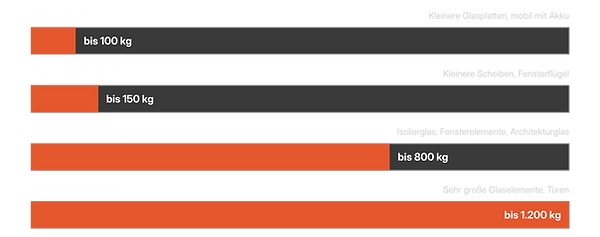
Lifting lift ZH up to 100 kg, rope manipulator up to 150 kg, articulated manipulator up to 800 kg, lifting axis ZH90 up to 1,200 kg, lifting and rotating device ZH up to 4,000 kg.
Internal handle, external handle, magnet or vacuum: The device is individually designed for each component.
Special manipulators for ATEX Zone 2 and 22, safety technology according to EN ISO 13849.
TISAX Level 2 with prototype protection, design and manufacturing in Germany.
CHAPTER 1
Why handling becomes a bottleneck in the arms ramp-up
Defense budgets in Europe are rising at the fastest rate in decades. For manufacturing, this means more shifts, larger production runs, and shorter delivery times, while skilled workers and factory space remain scarce. Key data (as of October 2026):
-
NATO: At the summit in The Hague in June 2025, the alliance states committed to spending 5 percent of their GDP by 2035, of which 3.5 percent would be for nuclear defense.
-
Germany: The government's draft budget for 2027 allocates approximately €110 billion to the defense budget and around €30 billion from the special Bundeswehr fund, totaling almost €140 billion. The 3.5 percent target is to be reached as early as 2029.
-
Ammunition: In 2025, Rheinmetall opened a new plant for artillery ammunition in Unterlüß and aims to produce around 1.5 million 155 mm projectiles per year by 2030.
The bottleneck in the ramp-up process is rarely the machine itself. It's the manual handling in between: moving components, loading them into machines, turning them over, and joining them. These steps are physically demanding, often require two people, and depend on the individual employee's performance on any given day. Handling technology decouples the output process from muscle power. It's important to understand that Zeilhofer doesn't manufacture armaments, but rather the systems that enable employees to safely move heavy components.
Sources: NATO, The Hague Summit Declaration , BMVg, Budget Debate 2027 , Rheinmetall, Press release dated 14.07.2026 .
CHAPTER 2
Typical components and their weights
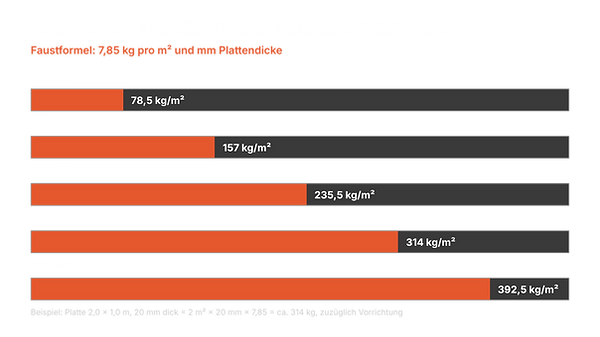
In defense manufacturing, many components are significantly heavier than what employees should be able to lift by hand on a regular basis. The article " How many kg can you lift?" explains the applicable limits. For plates, a simple rule of thumb applies: Weight in kg = Width in m × Height in m × Thickness in mm × 7.85.
-
Projectile body and casings : A 155 mm artillery shell already weighs over 40 kg; when fired in rapid succession, this represents a classic overload.
-
Steel and armor steel plates : 2.0 × 1.0 m at 20 mm thickness yield approximately 314 kg
-
Pipes and cylindrical parts : heavy, round, and therefore unstable when gripping.
-
Drivetrain, transmission and vehicle assemblies : off-center centers of gravity, sensitive functional surfaces
-
Electronic modules, containers and boxes : lighter, but in high quantities and frequency
The total weight of the component and fixture is always a key factor in the design. Also, be sure to include the heaviest part that will eventually run on the line.
CHAPTER 3
Which system for which component?
The choice of base system depends on the overall weight, range, and required movements. Zeilhofer considers five systems suitable for arms manufacturing, each with its own individual device:
-
Lifting platform ZH up to 100 kg: Mobile movement of boxes, electronic modules and small parts, battery-operated, without compressed air
-
Rope manipulator up to 150 kg: Sleeves and lighter components at high cycle frequency
-
Articulated manipulator up to 800 kg: rigidly guided, picks up, rotates and tilts projectile bodies, plates and assemblies
-
Lifting axis ZH90 up to 1,200 kg: heavy assemblies and pipes linearly and without pendulum movement, also integrable into lines
-
Electric lifting and rotating device ZH up to 4,000 kg: Lifts tubs, structures and large assemblies and rotates them 360 degrees.
.png)
For cylindrical loads such as pipes and sleeves, the guide "Roller Lifters" shows the appropriate fixtures. The guide "Sheet Metal in Laser Cutting Systems" explains how to load sheets into laser cutting machines and remove offcuts. The guide "Selecting a Manipulator Manufacturer" shows what to consider when choosing a manufacturer.
CHAPTER 4
Gripping, clamping, turning: the device decides.
Defense components are rarely standard. Therefore, the fixture is individually designed for each component, tailored to its geometry, weight, surface finish, and manufacturing process.
Inner handle and pin
Sleeves, tubes and hollow bodies are clamped from the inside, the outer surface remains free for machining and testing.
Magnet
Steel and armor steel plates are held in place across their entire surface using magnets, without drilling or attachment points.
Outer handle and prism
Projectile bodies and shafts are held securely from the outside, prisms center round parts safely.
Vacuum
Housings, covers and painted surfaces are gently vacuumed, with pressure monitoring and redundant circuits.
The article "Individual Grippers and Fixtures" shows how such special devices are created. When assemblies need to be rotated for assembly or welding, the ZH lifting and rotating device handles the 360-degree turning.
CHAPTER 5
Manipulator or crane.
Many companies today move heavy parts using overhead cranes or chain hoists. This works for infrequent lifts, but reaches its limits during ramp-up. The difference lies in the way the load is guided.
manipulator
guide
Rigidly guided, the component does not swing.
Positioning
Accurate to the millimeter, even when inserting into machines
Off-center loads
Are picked up without torque
staff
One person instead of two
Suitable for
Fixed workplaces, cycle and series production
crane or chain hoist
guide
It hangs from a rope or chain and swings.
Positioning
It takes time and often a second person.
Off-center loads
Tend to hang crooked
Availability
The crane is often shared by several stations.
Suitable for
Rare, very heavy lifts
You can find a general comparison in the guide "Manipulator, Crane or Chain Hoist?" . How handling technology compares to robots, cobots and exoskeletons is explained in "Automation without Robots" .
CHAPTER 6
Safety and explosion protection
Where heavy and safety-relevant components are moved, the safety of the system is part of the design from the very beginning:
01 Rigid load guidance
The component does not swing or strike. This protects workers and functional surfaces.
03 Redundant load protection
For vacuum systems, two separate circuits with pressure monitoring are used; for grippers, mechanical end-position locking is employed.
02 Safety technology according to EN ISO 13849
Depending on the application, up to performance level d, with emergency stop and placement only in a defined end position.
04 Explosion protection
Special manipulators for ATEX Zone 2 and Zone 22, designed according to the operator's zone classification.
Each system is documented in accordance with CE marking and the Machinery Directive and is designed for annual inspection according to DGUV Regulation 54. The guide "UVV Inspection for Lifting Aids" explains what is inspected during this inspection.
CHAPTER 7
Confidentiality and manufacturing in Germany
In defense technology, component geometries and process data are particularly sensitive and require special protection. Zeilhofer therefore works with clear rules:
-
TISAX Level 2 with prototype protection and ISO 9001, certified since 2008
-
Non-disclosure agreement before project start, documented access control and separate work areas
-
Design, manufacturing, assembly and service from a single source in Holzkirchen, without outsourcing design
-
In-house production on 2,500 m² of hall space; over 2,500 systems delivered since 1999
-
One contact person from concept to commissioning
CHAPTER 8
Ramp-up in stages: producing more with existing staff
Those who invest during the ramp-up phase don't have to change everything at once. Handling technology can be introduced gradually and grows with the order volume. This reduces the investment risk.
Ramp-up in stages instead of all at once
1
Relieve single workstations
Hardest job first: one person instead of two
2
Connect stations
One system serves multiple machines or test stations.
3
Secure the cycle
Pendulum-free and reproducible, independent of the operator
4
Expand the line
Semi-automated with synchronized axes
-
Increased output with existing personnel
-
Jobs can be filled more broadly, regardless of individual strength.
-
Fewer sick days due to reduced physical strain
-
Reproducible quality because the component is always guided in the same way.
The article "From Prototype to Series Production" shows how the transition from prototype to series production succeeds. What the ramp-up means for medium-sized suppliers is explained in the article "Defense Ramp-Up at Suppliers." The guide "Manual, Semi-Automated, or Robot?" describes the path to a semi-automated line.
CHAPTER 9
Zeilhofer at DSEI Germany 2027
Zeilhofer will be exhibiting at DSEI Germany, the new trade fair for defense and security, from March 9th to 12th, 2027 at the Hanover Exhibition Grounds. At our booth, we will be demonstrating how manipulators and lifting axes can reduce the workload in production during ramp-up. To schedule an appointment on-site, please contact us via our contact page .
CHAPTER 10
Costs and financing
The price comprises the basic system and the attachment. A simple cable manipulator starts at approximately €10,000 without installation and commissioning, while complex lifting axis solutions can cost up to approximately €150,000. The cost drivers are explained in the guide "What does a manipulator cost?" . Instead of a one-time payment, leasing and hire purchase are possible through Würth Leasing; all details can be found in the guide "Leasing and financing lifting aids" .
CHAPTER 11
Checklist: Your request needs this information
With this information, you will receive a reliable assessment and a fixed-price quote more quickly. We will only exchange confidential documents after a non-disclosure agreement has been signed.
-
Component, dimensions and maximum weight including fixture
-
Gripping surfaces and sensitive functional surfaces
-
Intake and storage: machine, test station, container, rack or line
-
Necessary movements: Lifting, rotating, tilting, turning, joining
-
Quantity per shift and planned ramp-up
-
Environment: Ex-zone, temperature, purity
-
Photos or sketches of the component and workplace, if approved
FAQ / Q&A
Frequently asked questions about handling technology in the defense industry
01 What is handling technology for the defense industry?
Handling technology for the defense industry includes manipulators, lifting axes, and lifting aids that lift, rotate, and position heavy components in the production of munitions components, vehicles, and systems without swaying. It relieves the strain on employees during production ramp-up and ensures reproducible processes.
02 Which components are handled with manipulators in defense manufacturing?
Typical components include shell bodies and casings, steel and armor plating, pipes, running gear and transmission parts, vehicle and structural assemblies, electronic modules, as well as containers and crates. A 155 mm artillery shell already weighs over 40 kg.
03 Which system is suitable for which weight?
The mobile Hebelift ZH lifts up to 100 kg, the Seil-Manipulator up to 150 kg, the Gelenk-Manipulator up to 800 kg, and the Hubachse ZH90 up to 1,200 kg, each including the necessary fixture. For lifting and rotating large assemblies, the electric Hub-Drehvorrichtung ZH is available with a capacity of up to 4,000 kg.
04 How heavy is a steel or armor steel plate?
Steel weighs approximately 7.85 kg per square meter and millimeter of thickness. A plate measuring 2.0 × 1.0 m and 20 mm thick therefore weighs about 314 kg; the weight of the fixture is additional.
05 Are there manipulators for potentially explosive atmospheres?
Yes. Zeilhofer manufactures special manipulators for ATEX Zone 2 and Zone 22. The operator determines the zone classification, and the system is designed accordingly.
06 How is confidentiality ensured?
Zeilhofer is certified according to TISAX Level 2 with prototype protection and according to ISO 9001. Projects are conducted under a non-disclosure agreement with documented access control and separate workspaces.
07 Does Zeilhofer manufacture armaments?
No. Zeilhofer develops and manufactures exclusively handling technology, i.e., the systems that enable employees to safely move heavy components in production.
08 Can handling technology be introduced gradually?
Yes. Typically, you start at the heaviest workstation, followed by further stations up to a semi-automated line with synchronized axes, tailored to the order volume.
09 How much does a manipulator for defense manufacturing cost?
Simple cable manipulators start at approximately €10,000 excluding installation, while complex lifting axis solutions can cost up to approximately €150,000. Leasing and hire purchase options are available through Würth Leasing.
10 Where can you meet Zeilhofer in person?
Zeilhofer will be exhibiting at DSEI Germany in Hanover from March 9th to 12th, 2027. The team will answer inquiries within 24 hours on weekdays.
READ MORE
FURTHER GUIDES ON THIS TOPIC

series
From prototype to series production

SUPPLIER
Arms ramp-up at suppliers
