Manipulator for OBC mounting: Precise handling of on-board chargers
Zeilhofer Handling Technology develops customized handling equipment for the assembly of electromobility components. Electromobility is introducing new components into vehicle assembly for which there is no equivalent in traditional combustion engine production. One of these is the on-board charger, or OBC for short. For production, this means a new assembly, a new assembly step, and new handling requirements directly on the assembly line.
This article shows the special features of OBC assembly, how a handling device secures the process, what role the gripper plays, and which systems are suitable for which load ranges.
What is an on-board charger?
The on-board charger, also known as an on-board charger or vehicle charger, is the permanently installed charging device in an electric or hybrid vehicle. It converts the alternating current (AC) from a household socket, wallbox, or public AC charging station into direct current (DC), which the traction battery can then absorb. It is bypassed during DC fast charging; during any AC charging cycle, it determines the maximum possible charging power.
Technically, the core of an OBC consists of an AC/DC converter stage with power factor correction and a subsequent DC/DC stage. This power electronics is housed in a robust, usually water-cooled aluminum enclosure with sealed high-voltage and low-voltage connectors. While the component appears insensitive externally, it is highly sensitive internally. This very contradiction shapes the requirements for its assembly.
Why OBC assembly places special demands
The OBC is typically bolted to the bodywork in a continuous process. Unlike simple add-on parts, this involves several requirements simultaneously:
The OBC must be safely removed from the delivery container without damaging any connector surfaces, sealing surfaces, or cooling connections.
It must be moved towards the body in a controlled manner, including a swiveling movement into the correct installation position.
Until it is fully screwed in, it must be held exactly in position without the worker having to bear the load permanently.
Depending on the vehicle variant or charging capacity, different OBC variants are used, which should be able to accommodate the same device.
The installation space in the lower body area is limited; interfering contours are not permitted.
Everything must function in sync with the beat, without any loss of time compared to the tape speed.
Furthermore, there is the economic aspect: A damaged OBC is not a cheap item. Scrap due to uncontrolled movement or impact during handling costs more than the handling solution that prevents it.
The assembly process step by step
In practice, the process is divided into five sections, which a handling device should cover completely:
Removal: The gripper picks up the OBC directly from the logistics container, without intermediate storage and without manual repositioning.
Transport: The component is moved to the bodywork suspended and guided; the worker only indicates the direction.
Alignment: The OBC is brought into the intended installation position via swivel and rotary axes.
Holding: The device securely fixes the component in position while the screwing process takes place.
Return movement: After release, the device returns to the starting position for the next cycle.
Manipulator, manual labor or robotic cell?
There are basically three approaches to OBC mounting, and each has a clear profile.
Purely manual assembly without tools is the quickest setup and requires no investment. However, it puts strain on the worker with every cycle, and the risk of damage to the sensitive electronics is high. With increasing production volumes, it quickly becomes a bottleneck and a health hazard.
A fully automated robot cell handles all the movement, but requires high investment, complex programming for each vehicle variant, protective enclosure, and a corresponding amount of space. It is also inflexible when there are frequent changes to variants or layouts.
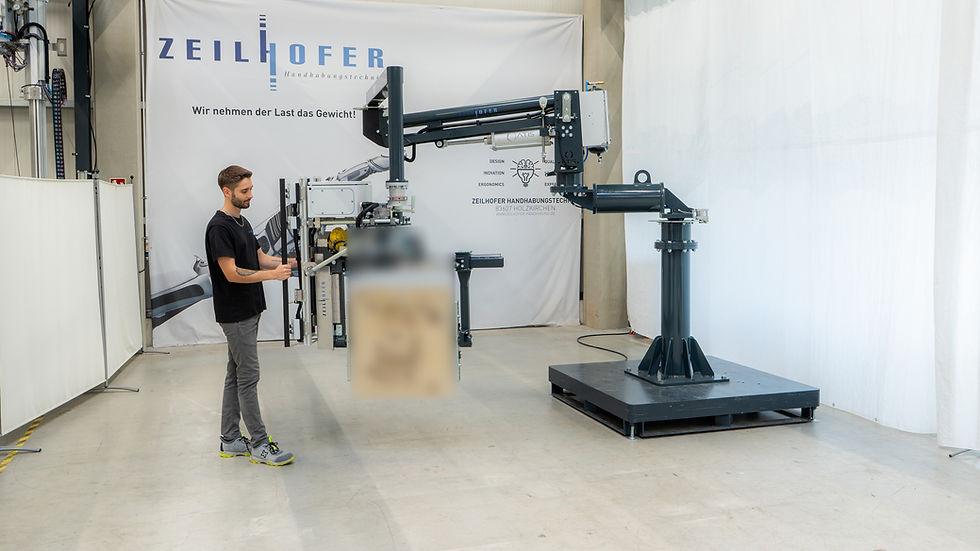
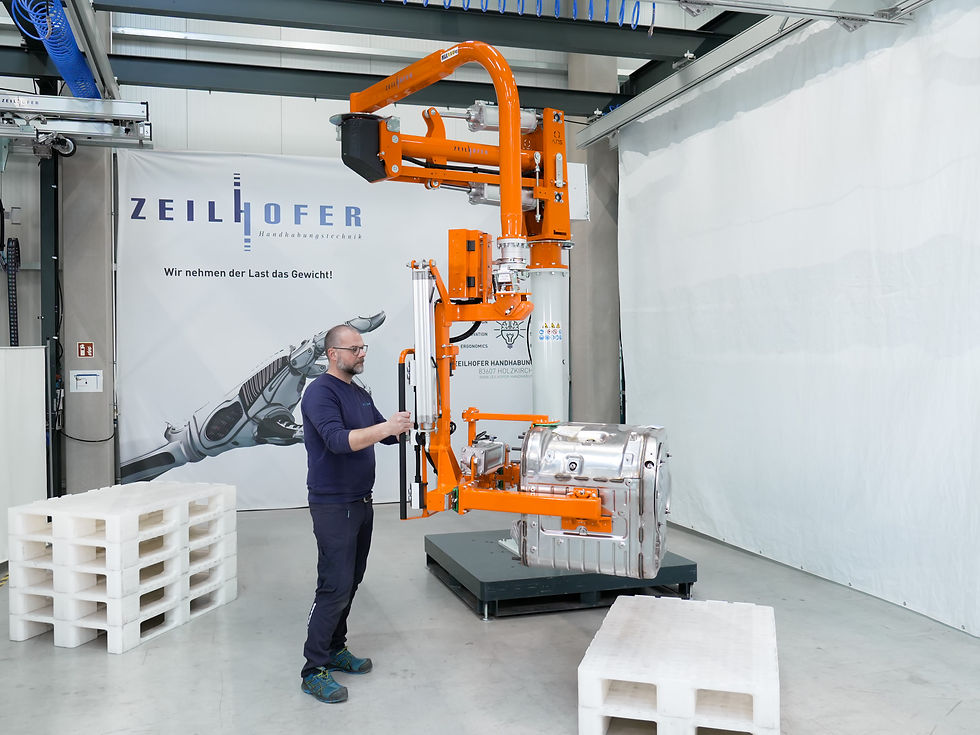
The articulated arm manipulator with its adapted gripper falls in between and best meets the requirements of OBC assembly: It relieves the worker of the weight and guides the component precisely, while leaving the sensitive fine positioning and screwing in human hands, where they belong for a safety-relevant component. It requires no protective enclosure, operates directly alongside the worker, and can be adapted with comparatively little effort when changes are made to the component or line.
Zeilhofer's handling solution for OBC assembly
Zeilhofer Handling Technology has developed a rail-guided handling device for OBC assembly, which is mounted above the assembly line. It follows the vehicle during continuous operation, allowing the worker to perform the entire assembly process while in motion.
A pneumatically operated gripper picks up the OBC from the logistics container, guides it in a controlled manner with a pivoting motion to the vehicle body, and holds it there in position until the bolting is complete. The gripper is designed to be able to remove different OBC variants directly from the delivery container without creating any interfering contours or requiring a change of gripper.
For plants that frequently adjust their production lines or relocate equipment between sites, the system is also designed for rapid relocation, including power supply and peripherals. Engineering, design, manufacturing, commissioning, and service are all provided by a single source in Holzkirchen.
The gripper determines process reliability.
Every lifting aid is only as good as its fixture. With OBC (End-of-Arm Tooling), the gripper must engage surfaces that are mechanically robust and consistently leave sensitive areas such as connector contacts, sealing surfaces, and coolant connections clear. At the same time, it should be able to handle multiple component variants so that a second fixture doesn't need to be kept on hand in the factory. The overview of fixtures, grippers, suction cups, and magnets shows how such end-of-arm tooling is created, from the gripper to the suction cup and on to the special fixture.
Safety, standards and plant security
A handling device for OBC assembly is a load-handling device and is therefore subject to the Machinery Directive. Additional requirements apply for continuous line operation:
CE conformity for the entire system including device and control
Testing and documentation as a load-bearing device, for example as part of a TÜV check
Recurring UVV inspection according to DGUV regulations during ongoing operations
Safety-related integration into the belt control system to prevent collisions between the device and the conveyor technology.
Acoustic or visual warning before the device enters a safety area
Designed for different load ranges
Unlike heavy assemblies such as high-voltage batteries or cockpits, the focus in OBC assembly is not on maximum load capacity, but rather on precision, repeatability, and careful handling of a sensitive component. Depending on the requirements, different systems from the product overview are used:
Articulated arm manipulator : pendulum-free up to 800 kg, working radius up to 4.5 m, ideal for swiveling and positioning at a fixed station
Acer and ZH70 rope manipulators : lightweight, fast and integrable into any rail system, for loads up to 150 kg
Hub axis ZH90 Flex-Arm : combines rigid Z-guide with articulated arm, up to 200 kg, for applications requiring vertical precision and horizontal reach
ZH90 lifting axis : linear Z-axis up to 1,200 kg for heavy assemblies in the same production environment
This means that one supplier covers the entire spectrum of e-mobility assembly, from delicate power electronics to complete batteries. The article "Battery Module Handling: Safe in E-Mobility" shows how this works with heavy components. The guide " What is a Lifting Axle?" explains which system is generally suitable for which direction of movement.
Economic benefits
The benefits of a handling solution in OBC assembly can be summarized in four points:
Less waste because the component is guided and precisely picked up and placed.
Reduced physical strain and therefore fewer days off work due to overhead and awkward postures.
More stable cycle times, because the process remains reproducible regardless of daily form and physical strength.
Increased acceptance in the workplace because one operator can handle the component alone and safely.
Areas of application
Handling equipment for on-board computer (OBC) assembly is used wherever electric vehicles are mass-produced, regardless of the automotive manufacturer. With increasing model diversity and growing production volumes in electromobility, the ergonomic and reliable handling of these new components is becoming increasingly important for more and more plants. Zeilhofer Handling Technology is ISO 9001 certified and operates according to TISAX Level 2 with prototype protection, which is particularly crucial for confidential automotive projects. Their systems are in use in 18 industries and over 50 countries.
Frequently asked questions about OBC mounting with manipulator
What is an on-board charger?
The on-board charger is the charging device permanently installed in an electric vehicle. It converts alternating current from a wallbox or socket into direct current for the traction battery and thus determines the vehicle's maximum AC charging power.
Why isn't a simple mounting system like other attachments sufficient for the OBC?
The OBC connects sensitive power electronics with tightly sealed connectors. An imprecise grip or an impact during insertion can damage the component or sealing surfaces. Therefore, the gripper must be precisely matched to the geometry and sensitive areas of the OBC.
Can one manipulator handle multiple OBC variants?
Yes. With a suitable gripper design, different OBC variants, depending on factors such as loading capacity or vehicle model, can be removed directly from the delivery container using the same device. Changing the gripper is unnecessary.
How is the OBC held securely in place until it is screwed in?
The handling device secures the component in its intended installation position and holds it firmly in place until the operator has completed the bolting to the body. The operator does not bear the weight of the component at any time.
Does this also work in continuous operation?
Yes. The handling device is guided in a rail system above the line and follows the vehicle, allowing assembly to take place while the vehicle is in motion. For system safety, it is integrated into the conveyor control system.
Does a handling device for OBC assembly need to be tested?
Yes. As a load-bearing device, it is subject to the Machinery Directive and is inspected and documented accordingly, for example as part of a TÜV inspection. During operation, recurring UVV (accident prevention regulations) inspections according to DGUV (German Social Accident Insurance) regulations are also required.
Can the system be moved to a different location?
Yes, provided this is taken into account during the design phase. Zeilhofer designs handling equipment for automotive production upon request so that the device and peripherals, including power supply, can be implemented quickly.
Pneumatic or electric.
For OBC assembly, the gripper is typically pneumatically operated because compressed air is readily available in assembly lines and pneumatic grippers are fast, robust, and easy to maintain. Where compressed air is unavailable, electric versions are possible.
Are you planning how to handle your OBC installation?
Zeilhofer Handling Technology develops customized handling solutions for the assembly of on-board chargers and other electromobility components, from concept review and design to manufacturing and commissioning on the production line. We analyze your process and develop a suitable manipulator or gripper . Request a free consultation now.